Slow Horses DP Eben Bolter: creating a darker, grittier season 6
Slow Horses DP Eben Bolter on shooting season six using imperfect light, a location lit with green LED tape, choosing gray screen over green, and a dark, wet London look. Podcast highlights include: -How imperfection makes light feel real. Eben sets the scene and lets actors move through it freely, using hidden practicals and uplighting that’s sometimes unflattering, but gives the show a sense of reality. -How the dramatic scene set in a London fast food restaurant was lit. What’s seen on screen is what they shot, with no VFX or grade enhancement. -Using gray screen for compositing, rather than green or blue screen. We get into why. -How Eben kept it gritty. By evoking the feel of bleach bypass and deeper contrast. Then punctuating the look through key scenes like a chase through a colorful bowling alley using 200-plus LED fixtures. Find Eben Bolter: https://www.ebenbolter.com/ Instagram: @ebenbolter Show Rundown: 02:25 Close Focus 13:52- 01:06:40 Interview with Eben Bolter 01:07:03 Short Ends 01:21:42 Credits The Cinematography Podcast website: www.camnoir.com YouTube: @TheCinematographyPodcast Facebook: @cinepod Instagram: @thecinepod Blue Sky: @thecinepod.bsky.social
Show notes
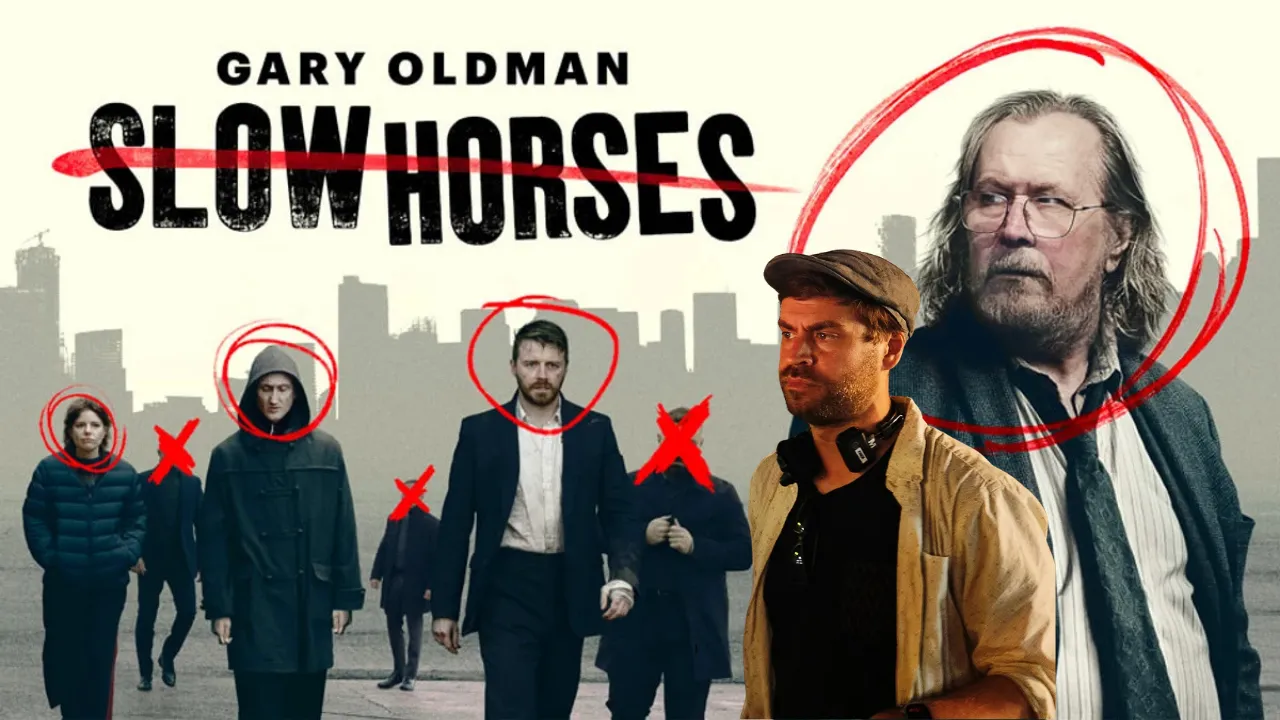
Cinematographer Eben Bolter, ASC, BSC shot all six episodes of season six of Slow Horses, Apple TV’s hit spy series with director Adam Randall, a longtime collaborator. “There’s a point where I felt like we could tip into being too slick, too cinematic, too lit,” he says. “I was really conscious that this isn’t Bond and the Slow Horses operate on a level below that. There’s a slight grunginess and realness to Slow Horses.” He explains how imperfect light made the show feel real, how a Shake Shack became a practical lighting build, and why he’s done with green and blue screen.
Season six is darker and wetter than what came before. The Slow Horses are hunted and on the run, so Bolter and Randall leaned into a road movie, with No Country for Old Men as a reference. “Let’s really lean into dark, grimy, grungy, wet London and let’s make it feel cold and sad and miserable,” he says. A bleach bypass look, deeper contrast and anamorphic lenses raised the stakes.
Imperfection is key to the look of Slow Horses. On set, the actors move freely, with lighting from practical sources. “It’s that imperfection moment by moment that makes it feel like a grounded, real location,” Bolter says. “It always should feel like a tangible place you can smell.” That means uplighting, even if it’s unflattering, plus lamps, overhead florescents and hidden sources. Glossy beauty lighting would work against the show.
The Shake Shack meeting between Gary Oldman’s Jackson Lamb and Hugo Weaving’s Frank Harkness was the season’s centerpiece. It had to be cross-shot, read from outside the windows and be visible from far away at night. The location had one small green neon sign, so Bolter and gaffer Paul McGeekin extended the color around the restaurant. They ran RGB LED tape down the metal frames of the windows. “I really wanted it to stand out from the rest of the season,” says Bolter. “I didn’t really use green this strongly anywhere else. I saved it for Shake Shack. Every little bit of that green lighting in the window, my lighting team installed. They did an amazing job of finishing it to make it look like it had always been there. We set it to green, we put a little bit of blue into it, and it just gave us that sort of beacon of light that worked for the exteriors, worked for the interiors, and you know, what you see in the show is exactly what we shot.”
In a season of cold, desaturated tones, Bolter saved color for other set pieces. The bowling alley used over 200 LED tubes in the ceiling. “I really wanted to lean into the crazy neon chaos of a bowling alley and what that feels like,” he says. “It’s like here’s an opportunity to really do something. That’s kind of my happy place, actually, is just being able to not be boring with light.”
Season six also marked Bolter’s first time using a gray screen, with no green or blue screen. Gray allows softer light through the windows and avoids despill problems that can leave skin looking plastic. “I get essentially white light pushing in through a window, as it would in nature,” he explains. The tradeoffs are slower keying and gray-on-gray problems, like Lamb’s hair and wardrobe, but overall, he thinks he’s done using green and blue.
Bolter’s path to cinematography began as a child, falling in love with Spielberg movies. At a corporate marketing job, he began shooting mini DV videos and editing them. Later, while traveling, he found the Canon 5D Mark II and was hooked on digital filmmaking. “I’m a DSLR DP who’s somehow gone into these big productions,” he says. “I realized at a certain point, the beauty of filmmaking is somebody with no experience can make something. And if people like it, then they like it.”
Find Eben Bolter Instagram: @ebenbolter
Transcript
Read full transcript
INTRO: So my name is Evan Bolter and I'm on CinePod. INTRO, EBEN BOLTER: Shake Shack was always this kind of centerpiece of the whole series in some ways. We were always building to it and from that point onwards it was going to change again. So it needed to work from a distance visually. We needed it to feel color-wise. I really wanted it to stand out from the rest of the season. So I didn't really use green this strongly anywhere else. I saved it for Shake Shack. So every little bit of that green lighting in the window... that my lighting team installed. They did an amazing job of finishing it to make it look like it had always been there. We set it to green, we put a little bit of blue into it, and it just gave us that sort of beacon of light that worked for the exteriors, worked for the interiors, and you know, what you see in the show is exactly what we shot. We put so much work into getting that right. It was actually very gratifying that it worked. INTRO, ILLYA FRIEDMAN: This is Cinepod, the cinematography podcast, a program about the art, craft, and philosophy of the moving image presented by Hot Rod Cameras. I'm your host, Ilya Friedman, and today on our show, I speak with cinematographer Eben Bolter, ASC, BSC. His earlier credits include the TV series The Last of Us and Cape Fear. Most recently, Eben shot all of season six of the hit Apple TV series Slow Horses. We dive into how imperfection makes light feel real. Eben sets the scene and lets actors move through it freely using hidden practicals and uplighting that's sometimes unflattering, but gives the show a sense of reality. How the dramatic scene in a set in a London fast food restaurant was lit. What's seen on the screen is what they shot, with no VFX or extra grading enhancements. Using gray screen for compositing rather than green or blue screen, we get into why. How Ebon keeps it gritty by evoking the feel of bleach bypass and deeper contrast, then punctuating that look through key scenes like a chase through a colorful bowling alley. using 200 plus LED fixtures. After the interview, stick around for our short ends, our pet obsessions of the week. But first, find out what's going on in the world of entertainment in a segment called Close Focus. ILLYA FRIEDMAN: Hey, Ben, it is time for our Close Focus. It is what is going on in the world of entertainment. What's going on this week? BEN ROCK: Well, instead of talking about You Can See Everything, we decided to talk about Elon Musk and Grok because when over the summer, when Christopher Nolan's landmark movie, The Odyssey came out, it really boiled Elon Musk's blood that in the act of adaptation, Christopher Nolan had changed some things, which I would say is absolutely necessary for adaptation. And so he swore at that time. that he was going to release his own version of the Odyssey that was going to be AI generated. And for those of us, not including me, who couldn't wait to see it, it arrived, I believe today as we're recording this, the first chapter of the Grok fully AI generated Odyssey. And you and I have both watched chapter one, which is, I don't know, what, about six minutes, seven minutes long? IF: Exactly. It's seven minutes and 12 seconds. BR: I think I liked it more than you. I don't know. But Illya, what are your first reactions? Is Christopher Nolan going to be on the bread line now? Is he done? IF: Yeah, Christopher Nolan is done. No, no, absolutely not. For me, I feel it's very perfect timing that we're doing this for Close Focus because I was at a party on Saturday night in Santa Monica with a bunch of people who'd been to LA Tech Week, which LA Tech Week is essentially now nothing but AIs. all the time and AI media and AI this. And they were a bunch of people there calling themselves AI filmmakers. And I'm still yet to see anything that is AI generated that gets me here, that gets me, that makes me feel something. It makes me feel any sort of empathy for what's going on. And despite Elon Musk's Grok Odyssey being beautiful, it is beautiful, that's never been... with movies making a beautiful image has never been the problem it's actually making the audience care what's going on and in that regard elon musk's odyssey is a massive failure at least for chapter one i felt nothing i felt nothing BR: yeah i i agree performances i felt, I will say, though, like, I mean, like, I have to admit, like, on a cinematic level, you know, the shots look great. The, you know, like there there's a lot of great detail and a lot of great color and design. And, you know, there's an aesthetic to it. You know, like, I'm not going to sit here and say it looks like crap. I don't agree with the philosophy of being an AI. filmmaker, but I'm not going to say that, you know, don't do it. Like, do it. Prove me wrong. Like, go make a great film. I'm not going to punch down. But when you hear that, like Neil Blomkamp made his sci-fi horror short recently, I watched that. And I wanted to watch this just to go like, OK, if there is a state of the art right now, this is probably it. And the shots, the lighting, the rendering, it all looked pretty good. IF: I want to interrupt you, though. BR: Please do. IF: People have been able to make beautiful, beautiful movies with or without a budget for 100 years of cinema. That's never really been the big problem. What the problem is, is this perception of people out there that I'm a disenfranchised filmmaker because I don't know how to make that or I can't afford to make that or I don't want to go through the effort to do that. So now I can use AI to solve what they ostensibly believe is the big problem, is making these visuals. That's never been the problem of filmmaking. The problem of filmmaking is getting audience to care what's going on. BR: Well, yeah. And that's about writing and that's about acting. And the writing and acting in this, I mean, there is no actors. There are no actors. It's all AI robots who are responding to a prompt that somebody gave them. And it's terrible. IF: And frankly, the robot performances are absolutely terrible. I would also go so far as to say that the writing is not good either. How much you want to bet it was AI, you know, it was written in some kind of chat GPT or something? BR: I won't take that bet. I'm sure it is. I don't think there was very much human involved in any of this. But I think that like the hilarious thing to me about this is that this is all about historical accuracy, like doing a historically accurate version of the Odyssey. And it's in English. To which I call bullshit immediately. Like if your goal is make it historically accurate, you should do it in Greek in verse because that's how it was freaking written. Like what are you even doing? IF: What I kept thinking the entire time of watching Elon Musk's Odyssey was that this is an animatic. This is a really good simulation visual of what a movie could be or could look like. BR: Oh, yeah. Yeah. If that's the future of Previz, then, you know, bully for them. I mean, you know, Previz has gone from being kind of like a very expensive dark art to, you know, I was watching a video about how on Obsession they used Unreal Engine to Previz the whole movie. And it's like, well, Unreal Engine is free. IF: You know what? No paying audiences are going to go watch the previs of something. The previs is not the point. The previs is to provide a blueprint for the filmmakers to be able to make the movie. What Elon Musk's Grok Odyssey is, is a blueprint for someone to actually go make a movie, not the movie. To go make kind of a... version of the movie is BR: i mean exactly i don't know it's the first seven minutes where it's the first seven minutes i'll see what they do when we get to the trojan horse or you know the cyclops or whatever like i'll watch that i'll be interested to see what uh far superior thing he thinks he's done being the richest man in the world i mean the problem is that people like someone who is crazy rich thinks that they because they're rich they know better experts who do this stuff day in, day out. And you can just disagree with Christopher Nolan's adaptation all day long. I've watched videos where historians or whatever, you know, pick it apart, but it's like, it's an adaptation. It's an adaptation of something that's the movie. IF: Yeah. Yeah. It's supposed to be entertaining. It's supposed to be fun. And in that regard, I was entertained. I mean, I didn't fall asleep. BR: Didn't fall asleep. Put that on the poster. Fully, fully awake. Three hours. IF: You know what? I liked it. I liked the Odyssey. Was it the best thing I ever saw? No. It didn't make me jump out of my seat, but I liked it. I was entertained. It did what it was supposed to do, and it did it far better for me than what I believe the rest of Elon Musk's Odyssey is going to look like. BR: yeah i mean i really liked it i would say it was one of my favorite christopher nolan films i don't love everything he does automatically but i would call myself a fan of his work for sure i i love a lot of his films and i would put it at the top of i would put it up there with inception and in terms of what it did and it's something that i will definitely return to and watch over and over again this less so in talking about the ai and i feel like we talk about ai a lot and and this has nothing to do with the film business IF: you can't help it it is kind of the spirit of the times right now it's what's going on in the world. BR: Well, and on that topic, in a different world from Grok, we're looking at a November IPO, that's Initial Public Offering. So they're going to go public with Anthropic, the makers of Claude and Claude Code and a bunch of other AI products. And I was reading a Reuters story about it, and maybe a business head could set me straight, but it seems like it mostly loses money. like as far as i can tell and yet it's valued at like 1.5 trillion which is a write down from the 2 trillion that they used to think that it was worth according to reuters IF: i feel like that's a big money grab it's them trying to justify their valuation before they fall further BR: Yeah, well, and part of it is like they made like $1.62 billion after losing $1.85 billion last year. And I'm like, so what you're saying is... IF: I think they lost that. BR: No, I think it was $1.85 they lost in the first half of this year. But they're going into this with like billions of dollars of debt. And if one is to believe writers like Cory Doctorow, a lot of these giant AI... are sort of just passing massive debts around to each other and calling it profit somehow. It seems like a magician shell game to me. AI is like freaking crazy pants. I mean, like when you talk about going to that tech forum and everything's AI, I remember being at NAB with you and everything was 3D and, you know. Didn't stick around. I mean, 3D didn't go away. There are still 3D movies that get made, but it's not, it didn't become the giant mainstream must have thing that they thought it was going to be. There's fads, I guess is all I'm saying. And, you know, is AI a fad or are we going to like pay money to go sit in a movie theater and watch AI movies? I feel like, I just feel like there's too much pushback against it. IF: There has been AI used in tools and in filmmaking for decades already. I mean, depending on how. you want to classify it but the latest generation the large language models of the major corporations that are being used you know the the Higgsfields and the Claudes and the whatnot to generate shots that get inserted into things not necessarily invisible not seamless uh if you want to look at really really good ai being used into stuff that people have no idea it's there there's a company called Eyeline which is wholly owned by netflix netflix it's their sort of like in-house vfx company they're using ai tools and ai stuff all the time and no one is the wiser and i think ultimately that's what it's going to come down to it's like if you can use an ai tool that completely doesn't reveal itself of being ai The audience isn't going to know and there isn't going to be this thing. BR: Well, this is what I've been saying. I've been saying it on here, on this podcast for probably at least four years now, that I feel like AI is going to be at every level of the visual effects world because it gets photorealism so well. When I look at this Odyssey thing, that's what it's doing right, is it's getting very good photorealism. And if an artist could harness it, I mean, there's just this past week, Corridor Digital released their Corridor Key version 2.0. which is a free download and it's them using AI to assist Chroma Key. workflows and it does things that are very, very hard for other systems to use. IF: But to me, that's like using it like a tool as opposed to using it as the whole end product. And frankly, that is exactly what people like Ben Affleck and other major sort of AI proponents in the industry have been saying for quite a while. It's like this is a tool to be used as a tool, not as a replacement for all of the things that, frankly, humans do so much better than computers. I have said it on the show. I will say it again. I would rather watch the movie Once, the movie Once, not A movie once, but the movie Once, that came out many years ago now at Sundance, but we shot standard definition and looks like, frankly, a hundred miles of ass. I would rather watch that movie again than any big, slick, soulless, glossy. AI or not AI. I'd rather watch it, frankly, than it than any Michael Bay movie, because I feel like Michael Bay in some ways to me feels like the AI of human filmmakers. I don't have any emotional connection to a lot of Michael Bay stuff. But that being said, how you want to invest your time, I want to invest my time in an emotional experience and something that makes me glad that I watched it. I don't care about just big explosions. Maybe I'm in the minority. Maybe people just want big explosions. But an AI will be entering a golden age of explosions. I think more. audience members are like me than like that. BR: Yeah. Well, anyway, I think we should go ahead and get to the interview. IF: Let's get to the interview with Eben Bolter. BR: Here we go. IF: I'm joined now by cinematographer Eben Bolter, ASC. Welcome back to the Cinematography Podcast. EBEN BOLTER: Thank you so much for having me. IF: Last time you were here, you talked with my co-host Ben about Cape Fear. And you've got a little show going on right now. And by little show, I'm, of course, understating this entirely. It's one of my favorite shows on television. It's called Slow Horses. And it's now in its, what, sixth season? Is that what you guys are on? EB: Season six. That's right. IF: It's fantastic. I love the show so much. And I'm kind of curious, though, as someone who is shooting the show and is making the magic happen week in and week out. What do you credit the success, the magic melting pot of elements that all goes into this to make this show such an incredible hit? Because on its surface, it feels like it could be something that would be like a very standard, not quite procedural, but sort of like a whodunit spy type of thing. But it's anything but that. It plays with convention. It plays with it so smartly. And it... an incredible cast, smart writing, beautiful visuals. Where do you put your finger on those successive Slow Horses? Where does it come from? EB: Well, thank you. I mean, I think you've just done a better job than I could ever do. I mean, I think, you know, first of all, the source material, the books are incredible. The writing's incredible. The world building is incredible. I think... People love a spy story. There's something about kind of peeling back the layers of what we think we know about the world and the kind of stories that go on in between those layers that we don't always know about. I mean, obviously, you know, James Bond being the kind of classic spycraft thing that everyone just loves. IF: It's so entertaining, I think, to sort of see. uh you know smart people will be smart and figure things out and save the world and and not always get the credit for it and what's so great about slow horses for me is it takes all of that and then just gives it this little kind of british reality twist where it's sort of not quite Bond. EB: These are the Bond rejects, these are the people who have have you know made a mistake not not bad enough to get fired but bad enough to get shipped off to Slough House and that gives them in a way a bit of a superpower because they because they're the the mess ups they also can kind of bend the rules a little bit more and not be held quite as accountable. That gives them this kind of, yeah, like just a different approach to spycraft. And I think obviously the characters are so fascinating and three-dimensional. And when you first meet Jackson Lamb, it's hard to know what to make of him and i think even six seasons in you get these little glimpses of what has made this character who he is um but i just find him you know on the surface incredibly funny and entertaining but there's so much depth there that the the character the writing and Gary's performance is sort of just slowly letting you in on that i just think it's entertaining and fascinating to watch and it was really interesting for me to come into this as a fan of the show it's not a thing I've done before I've only ever I've been lucky to only shoot sort of episode ones and and you know series ones and sort of set up the world and i wasn't sure i loved the show but when it kind of came around as an opportunity the first thing that actually attracted me to it was the director adam randall was a longtime collaborator of mine we've done three movies together old friends and so with him doing it i'm almost going to do anything he does but then also loving so what's the show it was like well this is not something i can say no to but i was interested like Am I going to have to come in and do an impression of somebody else? Because, you know, as cinematographers, we all see things slightly differently. And I actually think, you know, following someone else and having to keep things the same. can be harder than starting something afresh where you're just kind of pure creation. But the beautiful thing about Slow Horses from a production perspective is it's one director, one DP for the entire season. So it's not like you're bouncing between DPs and having to kind of meet in the middle creatively. It's just pure director, DP. We've got six episodes. Treat it like a movie. And the producers and Apple were incredibly sort of generous and open to you guys can approach this however you want. And it's kind of a case of keep what you liked and also, you know, change what you want to change, innovate where you want to innovate. And almost like the Bond movies, it's kind of like if you took the Daniel Craig Bond movies. They're all of a whole. There's five of them, I think. And they all tell a continuous story, but each film has its own flavour. It's all kind of, you know, they all look different, for want of a better way of putting it. And that's what I felt like with Slow Horses is we could just sort of do what we wanted. And so we could approach it completely with fresh eyes. What makes this season different? How do we kind of lean into the new opportunities? How do we set it apart? And not just to be different, to be different, but to just kind of treat it like on its own terms, what's the best approach to tell this story? And then, you know, keep a bit from the past and then sort of move it forwards into the future a little bit as well. IF: Yeah, I think that you described very, very well what I feel as an audience member when I'm looking at the various seasons, too, because when you came in and did an earlier day play or did an episode or so earlier as well, what season was that? EB: Yeah, so that's the other little kind of twist with me and Slow Horses is season three. I can't even remember why now. That's long enough ago that I can't remember why. For whatever reason, I was called in to shoot, I think, three days of... I can't remember if they were pickups or if I was just covering for Danny Cohen, but it was just a little three-day job, London. I'm not even certain that I'd seen the show yet. But anyway, I was asked to come in. It was Gary Oldman shooting in London, three days cover. Great, why not? I did it. I really enjoyed my time. Then season four, Adam Randall, who... collaborator he did all of season four I wasn't available to shoot it but the final two weeks of the season the DP Danny Cohen needed cover for the final two weeks so again I stepped in and covered those final two weeks then when I knew that I was going to have my own season in season six they needed cover for one day of season five so in a very strange way I've shot a tiny bit of three tiny bit of four tiny bit of five and all of Six. So I had a familiarity with the crew, with the production as a whole. And yeah, it was a very sort of warm start to life on Slow Horses because I'd had these little kind of tastes of it before. IF: I interviewed Danny Cohen for the show and we talked extensively about it. And for anyone who's listening to this show, you might also enjoy going back and listening to the conversation with Danny. But I think I'm kind of curious to figure out where the departures are because it's clearly season six is set in the same world. It doesn't feel like... are now in a different world. And the color palette feels very similar to the others, but there definitely feels like there's some stylistic changes. And I'd like to hear from you directly on the stylistic changes for season six. EB: You know, a lot of it's London. A lot of the locations, the office, slough house, you know, all of these things are the same. And I think Danny created a kind of grungy, mixed lighting, fluorescent, green tinged, cold world that I loved. What we did with Six was to sort of look at the story as a whole and a couple of things that were different this season. We felt that the stakes were higher this season. You know, the slow horses are literally on a... list and they're being hunted and so some of them are not going to make it and the stakes are very real and they're also going to have to go on the road you know slough house is in the first couple of episodes but then they you know they call a blake's grave and they have to go on the run So we knew this was going to be a little bit more of a kind of road movie, of a kind of a chase. And so, you know, the Coen brothers and particularly No Country for Old Men came up at the beginning as a sort of tonal idea, a dark, evil killer hunting. That sort of was a theme we had. and then it was about we were just talking about our favorite you know going right back to basics you know it's a london police spy thriller so we talked about all of our references for for that genre and what we loved and then the fact we're going to be shooting in the winter and we just decided let's really lean into dark grimy grungy wet London and let's make it feel cold and sad and miserable and this is the opposite of you know Hawaii in the summer it's the absolute opposite it's so it's just you know lean into all of those things that are kind of gross about London at times but also you know are very cinematic so so rain was a big thing color wise what I wanted to do in terms of just pushing it in it so direction was we were talking about bleach bypass a lot and so i wanted to lean into the cold hues of winter and i wanted to look at bleach bypass to kind of desaturate the world just a little bit more just to give it that little bit more i don't know sadness or darkness and threat I dialed up the contrast a tiny bit more. I wanted to have slightly inkier blacks this time. And then the other big change was to go to anamorphic lenses. It was the first time, you know, the season, all the seasons at this point had been spherical. glass I wanted to preserve the 2-1 aspect ratio which the show's always been but we did go to anamorphic glass which felt like another way to just slightly raise the stakes just give it that tiny bit more you know cinema be a bit more cinematic but I was really conscious of this isn't Bond and the slow horses operate on a level below that and there's a slight grunginess and realness to slow horses that I didn't want to tip into trying to be Bond. There's a point where I felt like we could tip into being too slick, too cinematic, too lit and so I was always kind of trying to keep myself in check as to is this still Slow Horses. We're elevating it, we're trying to be a bit more cinematic, a bit darker, a bit heavier but I don't want it to feel like an impression. of something else. It still needs to feel like Slow Horses. IF: I'm pleased to say, from my perspective, mission accomplished. It doesn't feel like the glossy James Bond sort of extra artifice. It does feel very grounded. It does feel gritty. It does feel dark. And I really appreciate some of the, I was going to say, this season feels like it's more night shots, more night shooting than any of the other seasons I can recall. And you've got all these great silhouettes. I can't recall which episode it is off the top of my head. but incredible chase sequences, incredible chase sequences that start in one place and end up somewhere else. And they're on foot and they're through buildings and in cars. And you end up with all these great opportunities where it's just sort of ambient light from the world or headlights or whatnot. This is what's causing the scene to be lit. I really enjoyed in particular the potential handoff, kidnapping handoff at Shake Shack. You know what I'm talking about? EB: Absolutely, yeah, yeah, yeah. IF: And there's this scene that takes place with Hugo Weaving and Gary Oldman and they're sitting there in the Shake Shack and you can see out the windows and there's all of these like fluorescent lights and sort of like ambient lights and they are green and they are like, you know, burnt umbra. They're all of these like colors and things, but also it's pretty, pretty dark for a Shake Shack. It's nighttime. And it's this wonderful scene that plays out. It looked to me like a real location. It didn't look like a set. Can you talk at all about how to kind of, especially the lighting and putting this sequence together? EB: Yeah, I mean, you'll have to stop me if this takes... I could talk about this one scene for probably 45 minutes. You know what? Just dive in. I mean, basically, when we were in prep, you know, when you're prepping a big TV series, particularly this model where it's one director, one DP, like on something like Cape Fear, I did every other episode. So you shoot and you prep and you shoot and you prep and you can move through it in kind of an organised way. When you're doing all six episodes, one crew, no downtime, your prep period becomes... this huge mountain of work ahead of you and you're looking at 300 pages or whatever of scripts and you start to sort of carve it up into importance and sometimes you're like okay it's a scene on a park bench daytime two actors let's forget that because we'll figure that out other times it's you know a chase through a cow farm and you know okay this is going to be a lot of lighting it's going to be technical we need to know our shots we need to know our angles Shake Shack was always this kind of centerpiece of the whole series in some ways it kind of felt like the kind of we were always building to it and from that point onwards it was going to change again so because it was the first time Hugo Weaving and Gary Gary's characters were seen on screen together. It's the first time those two characters meet. And it was a diner scene, people opposite each other. Very early on in prep, we were like, well, this is our De Niro and Pacino in heat scene. And, you know, it's sort of ridiculous to say, but we said it. You know, that's the obvious thing that this was. And what it also needs to do practically, it needs to function geographically in a lot of ways. We needed to have a location that when they're all in flight's apartment that reese could see out of the window a place a restaurant and say i want to meet at as he does shake shack so it needed to work from a distance visually we needed it to feel like color-wise I really wanted it to stand out from the rest of the season so I didn't really use green this strongly anywhere else I saved it for Shake Shack the way I got to that green and the way we lit it was Adam the director because of the nature of these two sort of titans of cinema meeting each other we wanted to cross shoot it so we wanted to give them the ability to play with the scene to play with each other and to be you know getting Gary's coverage at the same time as we're getting Hugo's coverage and also getting a two shot So I knew I needed to cross light it. I knew I needed to be able to do a lovely two shot at the same time. I knew I needed to be able to film them from outside the window as a two shot. So it has to work both sides of the line. And I knew we had to be able to see it from far away at night. So all of these elements that we had. IF: That's quite a laundry list of things. That's like that's basically saying you're going to see the world. You're going to see everywhere. So, I mean, does that mean that all of your instruments then have to be practical or hidden in some way or back far enough? Or how do you, how do you? Yeah, you're talking about 360. It's like that's everywhere. EB: Yeah. So so what that meant is I'd have to use sort of diegetic lighting. It would have to be lighting that we see in shot. It would have to be practical. So we found that Shake Shack location in Camden Town, London, and it had a good sight line for a very big wide shot that we could get as an element to put into Flight's apartment. It had a lovely high street outside where we could stage the scenes outside. And we felt that that view up there as a two shot was a great, you know, location just to set the scene. But none of that lighting existed. So what they did have was one tiny, this big green neon at the back of the restaurant that was like their logo, I think, from memory. And it was like, well, that's a cool little thing. What if we just... that out into the room and it was actually paul mcgeekin my gaffer and i who sort of stood there on the set and we were like okay what we should do here we just need to be able to sort of soft light them you know for cross shooting in in frame so what if we ran rgb ww led tape just all down the metal framework of these windows as if it had always been there so every little bit of that green lighting in the window my lighting team installed we used as much of that led ribbon as we could cram in there they did an amazing job of finishing it to make it look like it had always been there we set it to green we put a little bit of blue into it and it just gave us that sort of beacon of light that worked for the exteriors worked for the interiors and you know what you see in the show is exactly what we shot that's what it looked like in person that's what it looked like on the monitors at DIT and it hasn't been really enhanced or anything in VFX or the grade or anything I think we put so much work into getting that right. It was actually very gratifying that it worked. IF: Season six is currently streaming right now on Apple TV+. You're shooting season eight. Does that mean that season seven's in the can already? So did you do six and seven back-to-back? EB: Well, so no, I myself didn't. It's a new director in DP for season seven. The way it kind of works out, they like to, you know, this show is great and it's doing well and just keep it going, keep it going, keep it going. And the director of six couldn't have shot season seven because there's enough of a gap and they've got post-production. So, I mean, I can't really say too much, but yes, we're shooting. IF: You don't have to. I'm not asking for any spoilers. No, really. But I was just trying to understand the timeline. So it sounds to me, though, that. like you guys uh i mean is it is it almost a year-round schedule you get like windows off i mean certainly for the actors and then they're they're right back at EB: It is that is that what's happening with uh Slow Horses. Well season six we yeah you prep for you know three months or something like that and then you shoot for about four months um and then post it you know a good three four months quietly and then it and then it kind of goes again so um it it's one a year they kind of bunch two series together a little bit just to help with actors availability sometimes but they've got very good at making this work you've you've got you know actors who are getting bigger and bigger Gary Oldman himself And, you know, a lot of logistics, a lot of locations. It's a really, really big machine. And I've got to say the producers, everyone associated with it, is so great at making it feel easy, to be honest. Yeah. IF: Yeah. It's interesting, too. Like, I just heard sort of like the chatter recently, too, that Jack Lowden is being considered to replace Daniel Craig as James Bond. It's like that's like that's I have to imagine that slow horses had something to do with that. I mean. really, because it seems to me like, I'm not saying he came out of nowhere, but that's kind of, it's a pretty big milestone in any actor's career. So I don't know what's going to happen. But also, yeah, Kristen Scott Thomas, Gary Oldman, Christopher Chung, there's so many, I swear, it feels to me almost, it's like... It's a competition for scene stealing. It's like, you know, you put these people together and who's going to be able to steal this scene out because the performances are all so great. And of course, Gary Oldman, I feel like he steals almost every scene that he's in. But it's like when he's not in it, too, it's like it's almost this, you know, this competition between everybody else to who's stealing this other scene. And it's like the performances are so great and they compound on top of each other. These characters keep building. What's it like being on set when Gary Oldman's character, you know. burps or farts or does some of these moments that are so incredibly funny though too just like from a physical practical you know sort of like moment as an audience member is the crew just completely like detuned to this now or are you guys also busting up behind the scenes? EB: I don't think you'll ever detune to it. I think it's, I mean, honestly, you know, every day on, like, I think one thing about slow horses that I love is that every day is different and you get days where this is heavy and sad and serious and it's delicate and give the actors space and it's all about performance and it's not fun in the ha-ha sense. It's just... great to be there to witness great acting those days happen then we have our kind of bond days where we're doing a car chase action all of that stuff and they give us a lot of the toys to do that stuff really well and then there's the comedy and i think you know Tonally, the comedy is, you know, they play with the comedy a lot. So a lot of the scenes that you see have gone through iterations of more or less funny. And as a crew member, it's such a pleasure to watch them play with that. And I have got to see firsthand versions of scenes. much funnier than have made it to air because we never want to kind of risk veering into this is just an out and out silly comedy. But often, you know, they have the freedom and the space to play with scenes and to, oh, it would be really funny if I did this, you know. And we've got great source material, great scripts, great writers, but we've also got great actors. And the final rewrite really does happen in the room. And Gary in particular is the type of actor who is so... prepared he has been living with the text for months he knows it inside out but he'll come to set with an idea he always comes to set with an idea and that idea is sometimes you know i don't think i should be doing this whatever the thing is sitting standing or it can be as simple as i think i should be trying to light my cigarette or i think i should do this but other times it's I think I'm taking this too seriously and I should be undermining them with a joke and he'll have, he'll come with options and it's so... so great. Everyone has so much confidence in him and the characters and how they know their own characters that we give them the space to embellish like that. And it just brings the whole thing to life in ways where when you're just reading the script, it's almost impossible to have that sort of last minute magic that you get. It's really a joy. And we have scenes as well. You know, we've just had a few on season eight where the crew, you know, we rehearse the scene, we block a scene, then we do a crew show. And a couple of times this season, the crew have like spontaneously applauded at the end of a crew show, like it's live theater, because they're just so great at what they're doing. And we just know how lucky we are to be in the room to see it. IF: To jump back into lighting for a second. One of the things that... I notice about this show is that you are not afraid of uplighting at all on any of these people. And it's really wonderful because it's one of the things that people are taught in film school and almost always uplighting is unflattering. But uplighting is often the real world. That is absolutely, especially when you're talking about these environments and these dark spaces. And then there's a light that's set low and it plays on people's features in interesting ways. Can you talk a little bit about just the very selective use of uplighting in certain scenes where like your key light is actually maybe coming up from below. EB: This is a strange connection that makes sense to me because I'm me. It may not make sense out loud, but I'll say it because it's true. The Last of Us is where I really figured out my version of sort of cinematic naturalism where my approach on The Last of Us was create a cinematic situation and let characters move through it. freely in a naturalistic way so like the light is happening to do a thing through a window or whatever it is that's creating a thing where you kind of walk in the room and go wow that's great but it feels like nature's provided it or it feels like the lighting or whatever you've just stumbled upon a beautiful situation and then as you let characters move around that beautiful situation sometimes they'll land in the perfect pristine wonderful position but other times they'll be a little bit dark or a little bit bright or a bit front lit or you know it's that imperfection moment by moment that makes it feel like a grounded real location and so i've sort of taken that um well for most stuff i've done since then and and slow horses is a is a great sort of playground to use that same idea because again it's trying to create that cinematic situation but then giving the actors the freedom to not have to hit a perfect mark to not always everything be lit and so perfect and so sterile so often I'm creating often I'm using lamps and I'm bouncing them into white pieces of paper in vision that are creating a sort of soft up light or occasionally it's practical that we often shoot three cameras on the show and so often i'm having to hide lights either above or below just to not get seen by other cameras which makes them imperfect if i was doing real kind of glossy beauty lighting but all of that just feeds into this kind of imperfection idea that i'm always just thinking about and and often i do the opposite i sort of play the game of okay if this was a you know a watch commercial The light that's uplighting, I'd probably raise higher and I'd soften it. And I would probably, you know, turn that thing off and I would probably increase the backlight. And there's all these little tweaks I would do to make it better. But that would make it worse in Slow Horses land because it would feel more fake. It would feel more... We've dropped a VFX background into a studio shot of Gary Oldman. And that's kind of the last thing we ever want to do. It always should feel like a tangible place you can smell, you know? And so, yeah, that just leads to, I'm just all the time thinking about should i do more or should i do less you know I, I light the room, I see what the actors do and then we're, we're always talking about okay, should I soften that a little bit? Have I pushed the limits too far there or is that up light too strong? Should we dim that just a little bit? Or, you know, we have all these conversations and you've just got to kind of trust your gut and your instincts. And usually if you feel like, oh, do you know what? We've pushed the limits a bit too far there. Let's dim that down. That's what we do. But yeah, that's where a lot of the uplighting comes from is sort of living with that idea of imperfection to make it feel grounded. IF: That's an excellent examination of your process there. Yeah, I feel like it never goes. It never goes over. board but it's very clearly that there is a lot of intention that's going on with the light that's coming through coming from elements in the world and the the set and everything else I did also want to talk a little bit about camera movement. There's a ton of camera movement in the show. It feels very intentionally put together, how you're moving in from one scene, from one setup, from one shot to the next. And I think that possibly this season, though, there might be the most camera movement I've seen in any of the seasons. And I was wondering if that also was that maybe I was less conscious of it before. And I'm not saying that the movement always draws attention to itself, but there is an awful lot. I feel like as soon as I... appears to as soon as a gun appears now i know that we're going to be you know we're going to be following the action of who's going to where and what's happening this it's a coordinated ballet can you can you talk a little about your choices of uh for camera movement? EB: I mean I would credit all of that to our director Adam Randall. One of the reasons I love working with Adam is we're both children of Spielberg cinema. We both grew up loving the sort of Spielbergian camera move we're both really kind of attracted to that form of visual storytelling where the camera is a character the camera is forwarding the story is thoughtful about story thoughtful about character and hopefully doing several things as well it's not just here's a clever shot here's a clever shot it's combining ideas visually so that one shot can do three ideas. That's what we talk about all the time. And Adam and I first bonded talking about Spielberg and talking about South Korean cinema. So Park Chan-wook, Bong Joon-ho, the way they cover scenes, the way they move the camera is just something we've talked about the whole time we've known and worked together. Adam thinks in shots like a cinematographer does like he he is thinking he can say, Adam will come to me and say I've had an idea for this shot I want to start on the thing and as they pick it up I want to move to this thing and then I want to land in a two shot here for this moment and i want he can be so specific that my role becomes pull off the shot that he has in his mind and make it the best version of that shot that can be my role but also because Adam's so good at visual storytelling I also have to kind of keep up with him but then also offer him things like that as I see them so I need to be able to kind of speak his language as well and sometimes watching a scene if he's caught up in performance or a line that is is going to get tweaked I can be the kind of clear set of eyes to kind of go I've been watching the rehearsals and I think if we start here and move to here and do this and do that it's going to do all these things and he'll be like great so we've got this kind of you know double act Adam really enjoys a thoughtful camera move he doesn't enjoy neither do I unnecessary move that in any way feels cheesy it's you know if we're just you know if we're big push into a close-up and someone says a line like we're just not going to do that that just feels sort of icky for this show you know cheesiness is a thing that we sort of try to never be it's trying to be thoughtful with shot making and just keeping it rooted to story and character. IF: You guys pull it off it's it's really fun to watch. Season six definitely takes place in the rain, in London, and a lot of night shooting. But you guys, it is also a little bit of a road story. So you get out of the city proper and you're in a bunch of places. And it is so much night. It is night when you're in the city. It is night when you're in the country. It is night when you're at the river. Anywhere that you are, it seems like these nights stretch on. And then the days are relatively compact. Can you talk about the logistics or the difficulties or the... philosophy that you have to approaching so much night shooting, so much night shooting in the season. EB: So at a script level, we very early on realized that from halfway through episode two until the beginning of episode five, it's nighttime. That's not, you know, that's a lot of lighting to think about. So it became about how do we, how do we sort of categorize what we're shooting and keep the kind of geography of where we are relevant for the audience? So River and Sid kind of head off to the countryside. They start at David Cartwright's house and they end up in a, you know, a cow farm and hiding in an old lady's house. And, you know, their adventure is very much out in the sticks initially, and then they work their way back to the city. So I knew that... be in the middle of nowhere with no light sources no no sort of diegetic lighting so it would become moonlight and on a show like Slow Horses where we're trying to be cinematic but grounded you know moonlight i knew was going to be sort of for me internally contentious because it's very difficult to do naturalistic moonlight and yeah I mean honestly I just sort of have to credit the lighting department and production for enabling us to shoot that the way we did where we really could cut to a huge wide shot on the farm of them running away with a car following them. And, you know, I'm lighting up a massive area, a forest there, just using huge lights on huge cranes just to be as big and soft and even with the light as possible. And then all the while in the city, you know, making that feel different by using kind of warmer sodium and tungsten sources. And then once, you know, River and Sid worked their way back to the city, giving each kind of location its own flavor. IF: So like we talked about shake shack with the green but they go to the bowling alley. EB: Um yes the bowling alley is very memorable yes I really wanted to lean into just the the crazy neon chaos of a bowling alley and what that feels like kind of the over you know in a season that's so devoid of color that was so desaturated and cold it's like here's an opportunity to really like do something so we had over 200 led astera titan tubes rigged up into the ceiling of that bowling alley and all of that rainbow effect is all us, none of that was there so that was a lot of fun to just go really big with that i've shot a show in Hong Kong once and just to have the opportunity to just use color so freely is just so much fun that's kind of my happy place actually is just being able to not be boring with with light and to just really like have some fun with color and shape and yeah you know there's several other locations you know the beckonsfield services was a fun one we knew we had the fight in the toilet there to play with and i tried to give every location a little sense of visual geography so it felt like a progression And it never was a case of, wait, have we been here before? I wanted every scene to have something. IF: You're right. It is a very interesting contrast of just the... saturation and colors that happen in these these interior nighttime entertainment or shopping complexes that happened. And it's in hindsight now, like in watching it, it should have been almost like a visual clue to the audience that something really violent is going to happen now. Someone is going to meet their end or someone is going to have a horrible injury or get shot. It's like, because thinking about there is now, it's like each time one of these things happen, it's like, it's a major action set piece. I mean, yeah. the fight with Ko and everything else. It's like, it's a, it's these are, these are big pieces that. then get to be in full color and full saturation where the rest of the show is very much a slinking around in the darkness and desaturated and rainy and whatnot. So it's a wonderful juxtaposition. I hadn't really thought about that before, but I love it. EB: On Slow Horses 6, it was the first time ever I've done gray screen 100% exclusively. I didn't use any chroma green or chroma blue. I was 100% gray screen. And I personally learned so much from that process. that I kind of want to pass on. You know, it's like I want other DPs to just know the good and bad of my experience. Overall, incredibly good, but with some disclaimers of, you know, watch out for these things. IF: I got to ask you then, tell me about gray screen because like I've never talked to anyone about gray screen yet. So please break it down for me. What would someone need to worry about? Or what's the advantage of gray over green or blue? EB: Yeah. Well, this started from what was the advantage of green or blue? And the advantage of green and blue is we've done it for 20, 30 years. Everyone understands what it is and it's easy to key. That's why we use green and blue. The negative of green and blue is I always find, particularly in a show like Slow Horses, where I'm being subtle with colour, where blue, you know, imperfect lighting and, you know, green and blue getting onto skin via different sources. You know, the whole concept of de-spill is a sort of false idea. De-spill in my opinion doesn't work because you're you're asking someone with no close association to the show to either remove or keep green or blue that's making its way onto the set via a green or blue screen and how are they supposed to know whether you want that green or not or they should be removing it with VFX so it's easy for keying it's cheap for keying but the de-spill element becomes a big problem and in a lot of you know, DI sessions You know, we've had to ask for VFX shots to be resupplied because they've taken all the green out of someone's skin and it's made them look plastic, you know. And so I was just like, there must be a better way to do this in 2025, 2024, whenever it was we shot it. You know, do we really need like such a perfect key? Like my iPhone can key something in two seconds with no screen. So why are we still doing this? And I really kind of pushed VFX to explain why they needed it. And what it came down to is it's just, it's cheaper for keying. But I was like, fine. But overall, it's probably worse for everybody because if I can, instead of using a green or blue screen, if I can put a gray screen outside of a window, I am going to get the benefit of this big, soft in-camera source. I'm going to get essentially white light, pushing in through a window as it would in nature. And I don't have to worry about de-spill. It's all pure, good light. We can, you know, and, and for speed sake, you know, if you're looking at a green screen window, you light the whole shot and then you've got to light the green screen separately. And you're talking about de-spill. You're talking about levels. It's a whole extra element of lighting. And then you turn away from the window and you're turning the green screen off. And now you're trying to bring something in to emulate daylight. And all of that is slow, slow, slow. So if I can light a whole set with a gray screen out the window, can either look at it or not look at it don't worry about spill everything gets easier shots get easier lighting gets easier it's quicker production gets more shots it means keying is going to be a little bit slower for VFX and it means you do have to be wary about white on white or black on black or gray on gray so, on a nighttime scene where maybe I'm playing the grey screen quite dark, I've got to make sure that I'm not having a dark object in front of a dark screen and there's no colour contrast or light contrast there. Lamb, for example, wears a lot of grey clothes, has grey hair. I don't want to put him against a perfect grey screen because there's a certain point where, fair enough, he's going to disappear. And that is going to be a frame-by-frame keying. But with those couple of disclaimers, apart from that, it's just pure... win uh and i think there's a quite a lot of gray green and quite a lot of VFX in slow horses that i feel like you you probably wouldn't ever think about and i was able to just shoot it the way i'd shoot on location again without really thinking about messing around with green and blue out of a window. So I've kept that forwards. You know, when I did Cape Fear, that was all grey screen as well. And, you know, we're using grey screens again now. And I just kind of love it. I think I'm done with green and blue. IF: Yeah. Are you typically then underexposing the grey, overexposing the grey? How do you set that point of the grey? And what colour is the grey? Is it 18% or something different? EB: I think... It's not 18%. For some technical reason that I can't remember right now, I want to say it's 20 something, 25, 26, 28, something like that. For some reason, I haven't done my homework today to remember. I knew why two years ago, I've forgotten now. But the way we use it, we just dial it up and down relative to what I want the reality to be. So for night scenes, I tend to underexpose it. And for day scenes, I tend to slightly overexpose it and use it as a light source. If we've got a... critical difficult shot of I don't know motion blur in front of the grey screen I will at moments like that I'll talk to the VFX supervisor on set about how I can help like I appreciate we're making this shot harder for you we don't want to slow the whole production down by putting a green in just for this one little moment so what can I do and usually it'll be a case of how do we just get that little bit of contrast it doesn't really matter if it's brighter or darker so long as there's a difference and so really you're treating it more like a luma key and so is it a brighter foreground or a brighter background and you're just kind of playing with whatever the reality is in and outside of the room. IF: Yeah, it's fascinating. I wasn't aware that Slow Horses was doing this and it's super cool. Of course, gray screen is getting a bunch of notoriety right now because people are using gray for AI keying and that sort of thing, adding AI effects. But you guys aren't doing that at all. It's truly just to change the key and to not have color spill, which frankly, I've been there. There's nothing worse than when you've got a green source coming and it's like, I can't control the amount of extra green that's coming into this. And now someone else is going to have to work really hard to try to take that away. EB: Which you almost can, even on really big Hollywood stuff, occasionally I'll see a shot and I'm like, oh, they've struggled with that, you know? And it's a problem with an old fashioned approach. I think we should be past that point now. I don't think we should be worrying about spill. IF: Hey, let's go back in time. Where did you first get the bug? When did you decide that Being a cinematographer was something that you could do, that this was your calling or this is what you were going to set your mind to. EB: I got into this in a very strange way. Age 10 was when I saw Jurassic Park. in the cinema 1993 and that was a real moment for me of just being aware of the power of cinema and I'd always loved movies I had you know grown up with VHS's and I'd been watching Blade Runner and Alien and Terminator 2 and watching all these films I probably shouldn't have been watching yet but I remember really distinctly being in the cinema for Jurassic Park and it just sort of blowing my head off that created a real love for cinema cinema was my favorite thing movies my favorite thing and that carried on I went to university and I actually the idea of making movies I don't want to say it never occurred to me but it was just I had no connection to that world whatsoever I grew up on the south coast of England I knew nobody who had worked in film or tv that was just a kind of Hollywood thing that was over there I had nothing to do with that world but I knew about films and i knew you know i thought maybe i could work for a distribution company a sales company maybe a film festival and i wanted to get into the business of films somehow so i actually went to university and studied business studies um with marketing and i just thought that was a way to get a degree to get into a company and just try to find my way to kind of incorporate that into my love of film And then I ended up in a marketing division of a company who needed some corporate, nothing to do with film at all, but needed some kind of corporate videos shot. And they were like, we need somebody from the marketing team to just learn how to use Final Cut and to shoot like mini DV videos and blah, blah, blah. And I was like, oh, I'll do that. And they sent me on like a one week course for shooting and capturing video and then editing and Final Cut. And my job for a year became filming these silly kind of little commercials almost like just for internal use. I would shoot them I'd download the footage I'd edit them myself and I'd deliver them one per week you know I had an inherent I don't know I knew about shots just from my love of cinema I knew kind of how to compose and and that led to me you know getting into photography as well because I was becoming more aware of light and composition I was taking pictures and then I happened to be in Japan when the canon 5d mark ii released the firmware update that allowed it to record video so i'm holding in my hands a camera that could now shoot the best digital footage that anyone had ever seen i already owned it and i'd been doing this video work and i just started shooting stuff in japan and they were essentially animated photographs but japan being so incredibly beautiful they look good you know and i just started to kind of realize like oh maybe there's something in this like actually filming stuff and it was honestly as dumb as, like, I'm 20... three, 24 years old at this point, it was kind of like, huh, like, maybe I could do that. And it would become like, well, what's that person on set? Okay, it's a cinematographer. Okay, what are the films I love how they look? Who shot them? Okay, let's go down a rabbit hole of everything Roger Deakins has ever shot. Let's go down a rabbit hole of everything Darius Kondji has ever shot. And so I really was going down these rabbit holes of not directors anymore, but cinematographers, and then reading interviews, reading about, you know, making ofs, watching YouTube. videos about cinematography and I really started to feel like I just this this I feel like I've got there's something here I could do I moved to London to find a way into the industry now now thinking I wanted to be a cinematographer and what I realized was that in London there's so many there's such a buoyant film industry and so many people are making short films that I started to meet filmmakers who were looking for cinematographers and I was kind of like well you know I'll get a bit give it a go I've got this camera and I just started shooting short films without really knowing what I was doing, but we were just figuring things out together and I was making all the mistakes in the safety of a short film environment. And kind of before long, I'd shot a whole bunch of short films, which led to a feature film, which led to it. And I just sort of was doing it out of kind of thin air. And it definitely gave me an insecurity and a real sense of imposter syndrome that I'd kind of blagged my way to being a cinematographer out of thin air without going to like without studying it. But I just realized that because I was right on the kind of precipice of digital and film and digital was the new frontier and a lot of the old school cinematographers were a little bit scared of digital at the beginning. I was like, well, I can just be the digital guy. I can really not be scared of this technology. I can light with LED. I can use digital cameras and really kind of proactively try to innovate a little bit and use my inexperience almost as an advantage that I'm not stuck in old fashioned ways. And yeah, like I said, I think that kind of imposter syndrome made me fill in all my blanks proactively because I was so scared of getting found out. And just along the way, I just gained experience and gained experience and was filling in all these blanks. And then, you know, I'd never shot on film before. So, OK, I need to shoot on film just so I don't get found out that way and started shooting on film. And I just kind of found my way to legitimize myself. And I just sort of realized at a certain point the beauty of filmmaking. is somebody with no experience can make something. And if people like it, then they like it. And equally, somebody can work in the industry for 30 years and shoot something and someone can say, actually, I don't like that. And both can be true. It's art, you know. Here I am. I find myself on the set of Slow Horses after, you know, making little videos in Japan. IF: Was that feature breakthrough? Was that level up? Was that your first collaboration with Adam Randall? EB: That was my first film with Adam Randall. That's where we met. I had actually made, I want to say, six or seven features before that, but all such low budget. You know, it's hard to... I would place my first feature film as a film called The Forgotten, which essentially was a sort of riff on The Shining, but in a UK project like Council Estate. Really, really great script. Really great director, Oliver Frampton. I got that film. But before that, technically, I couldn't get a feature film because I hadn't shot a feature film. So me and a friend at the time made our own feature film, self-financed, literally like $2,000, like nothing. Favors from actors, favors from locations. But we shot a film called Red Heart, which was, you know, a romantic comedy, I'd say. But we made that to have made a film. It actually never was finished, never got released. But technically, we had made a film that was in post. And that helped get me my first film. which was The Forgotten, which led to another, which led to another. And then, yeah, I interviewed for Level Up, which was Adam Randall's first film. And then we did another film together called iBoy for Netflix. And then, you know, the rest is history. IF: Yeah, yeah. Well, that's really interesting. The Canon 5D Mark II plays a role in my early history in the technical side of this industry. When I started my own company, I got a little bit of notoriety for modifying those cameras and putting PL mounts on them and that sort of thing. And prior to that, I had actually had a buddy's cousin. buy a camera in japan to ship it to us and then i had to start learning Japanese to translate the menus because there was no english option on them at the time so i had to go through and then figure out so i could build my my first product some of those cameras were only available in japan and not worldwide. EB: Initially i had a digital Nikon camera and i spent a year traveling so really got into photography really got into you know lighting and just taking a million pictures and then i wasn't ready to come home but run out of money so I saw Japan as a way to sort of stay on the road so ended up living in Japan for two years teaching English doing whatever I had to do to just just be there still had a camera with me I met a bunch of creative friends one of whom was a professional photographer and she would take me out to take pictures we would just sort of go to places take pictures and she would talk to me about photography and she had a 5D Mark II and because I had a Nikon and she had a 5D I started to use her 5D and had all this footage though that I'd shot in Japan and and had it put together a reel that was way beyond what i've been able to do with a mini dv camera or something like that i am from that generation i'm a DSLR dp who's you know somehow you know got into these big productions um but That's the world I'm from. IF: I would say it was right place, right time. It really was a tremendously monumental transformation in the industry. And at the time, there was a lot of people going like, no one's ever going to use a camera that size to shoot feature films and entertainment. It was a very interesting time of transformation. And it seems to me like that you just happened to have this like lightning flash moment where you discovered that this is something that you could do and discovered that you loved it, which is super inspiring. That's a great story. EB: And it's actually, it's come a little full circle. I've just sort of realized as we're talking about. because today you know we're doing a lot of car work as we always do on slow horses and I've actually started using DSLRs to do some of our car work and we're shooting on the Alexa 35 and we're using anamorphic lenses and it's all big professional stuff. If we're doing a car rig we will often on a slider put three cameras in the back a kind of a two shot a French over and a French over all on DSLRs with PL mounts and they're Panasonic Lumix S1Hs I believe and they shoot 6K. They shoot, you know, they shoot log C now and they intercut, you know, 99% perfectly with the Alexa stuff. And we do have... Alexa 35, but the rigging time it takes to go from this to that, the ability to just kind of go plonk three cameras into the back of a car and get three shots simultaneously, and it takes no time at all, is such an advantage to the production. That's still a thing I do all the time. IF: Eben, I think that's a wonderful place for us to leave it. Is there a place on Instagram or the world that people can find you if they want to look at more of your work or get in touch? EB: Well, thank you. Yeah, I mean, Instagram, I am on there as Eben Bolter. I'm still... of figuring out you know what i should be doing on instagram but i am there i i once in a while i will post i i because i came from learning via behind the scenes i'm very aware of the lack of behind the scenes content these days without blu-ray special features it's such a shame like the lord of the rings making of is my film school basically and so i'm always trying to pass on things i've done because i think like so much of filmmaking is experimentation and you can learn from other people, whether good or bad. It truly can be, I didn't really like that. Why didn't I like that? How did they do it? And you learn from that. Or if you love something, how did they do that? I just think information sharing is so important these days. So yeah, on my Instagram, I do try to share how I've done stuff and I try to respond to people if they get in touch. IF: Yeah. Thank you so much again for being on the Cinematography Podcast. EB: Thank you so much. I really enjoyed chatting. Thank you. IF: All right. That was Eben Bolter. Eben, it was so great talking to you about slow horses. I loved season six and I can't wait to see the upcoming seasons of slow horses. BR: There are six seasons of slow horses. IF: Yeah. And seven is actually in the, in the can and eight is being shot right now. All right. So Ben, it is time for our short ends time of the show. We talk about our pet obsessions. What is your pet obsession this week? BR: I wanted to have a slight spin on something, which is the new documentary. You can see everything by Lance Oppenheim and Nathan Fielder, which I saw this weekend. And if you haven't seen it, you should go see it. I love documentary. You can see everything reminded me of another because I was I was sitting there thinking, like, who does documentary like this? Like what's interesting isn't. I mean, it's a very interesting film and it's a phenomenal character study and that's mostly what it is. But, you know, we're used to seeing documentarians like the two who pop into my head are like Nick Broomfield or Michael Moore kind of people who will put themselves into the film and they become part of the story, kind of that gonzo journalist kind of an approach. The thing about Michael Moore or Nick Broomfield, the two people I just mentioned, is that they're doing a kind of journalism. Like you can agree with it or disagree with it, but they're like digging for a story. They're trying to get facts out of people. They're interviewing people to get them to say stuff. And that is not the case with You Can See Everything. You Can See Everything is all about feelings. It's the feeliest film I've seen in a long time. And there's definitely a neurodivergence of some kind going on in Elizabeth Holmes. And I look at her and she's not seeing the world the way that I see it. And there's one scene in particular that I don't want to ruin for you, but there's one scene in particular where they're watching comedy together and she does not understand what makes it funny. She doesn't understand anything about it. And you're like... Like it was a stroke of genius on Nathan Fielder's part, by the way, because it took everything away from Theranos and fraud and her legal case and just was like, do you understand things the same way other people understand things? It was very interesting. And it made me think of Sherman's March. Have you ever seen Sherman's March? IF: I sure have. It's great. BR: For people who've never seen Sherman's March, it's Ross McElway. McElway whatever he gets like state funding he gets or he gets a grant to make a documentary about Sherman's March to sea in the civil war. IF: 1985 yeah it's been Yeah, it's been out for a long time. BR: Yeah. Yeah. And you can find it on Amazon. And when I was getting ready for this, I looked it up. They just did a 4K restoration like last month of it. So that probably means... I'll watch it again. There's probably... So basically, he's making this documentary about Sherman's March to Sea, but he's recovering from the end of a relationship right before he starts. And he starts documenting his personal life and the women who he's falling in love with. And then like... Stuff gets complicated between him and the women. And then suddenly he goes back to making the documentary about Sherman's March to Sea. And it's like one of the most personal and revealing documentaries I've ever seen. And in that regard, I feel like it had a setup, which is I'm going to learn about Sherman's March to Sea. I'm going to learn something about the Civil War. And actually... It's really just this very, very personal thing about the stuff going on in this guy's life and what his life is like and the women that he's with. And it's heartfelt. It made me feel a lot. And that was kind of how I walked out of You Can See Everything. Probably like a lot of people, when I saw that trailer, I'm like, oh my God, I can't wait to see how Nathan Fielder messes with Elizabeth Holmes. And then when you watch it, after watching it, I didn't feel that way at all. I felt like this is Nathan Fielder trying to grapple with the emotions that Elizabeth Holmes is grappling with in her own way. And I don't know that I'm selling it very well. I feel like it would be hard to explain it, but it's like you walk out of that movie with the experience that you were expecting if you know Nathan Fielder's work as one of the most subversive creators we have working in the industry today. But it's like... I deeply felt it really left me with it brought me in. And, you know, when you ask yourself, what are they going to do for three hours while I watch this movie? And, you know, why does everyone say it's not boring? Because it's not. You know, it has its own twists and turns as a documentary. But really, it's like you're grappling with the same thing he's grappling with. And the way he sets it up has some kind of like absurdist and funny and Nathan Fielder-ish resonances. But it's also going to take you on this kind of... wacky emotional journey that you're probably not expecting. And that was exactly how I felt about Sherman's March. So I was just going to say, if you can get a hold of Sherman's March, definitely see it. It's a masterpiece. And I feel like this might go down as its own kind of masterpiece. I mean, I feel like this is probably going to get more acclaim, like popular acclaim than Sherman's March. Sherman's March was not a box office blockbuster, and this for a documentary very much is. Those are my thoughts. I'll leave it at that. IF: The 4k restoration of sherman's march for its 40th anniversary went to theaters, I don't know when it's going to be available elsewhere but i'm certainly looking forward to seeing it stored in 4K, that would be awesome. BR: Yeah, I'm assuming there will be a 4K Blu-ray out momentarily if you're so inclined to be that kind of person. All right, so Illya, what is your obsession this week? IF: I got to go to a meeting with LA's film czar, Steve Kang. This was put on by Women in Media. So I guess if I was to sum it up, I would say that Women in Media and a group called StayinLA25, which has an Instagram account, which is at StayinLA25. It's run by a guy named Cale Thomas. I believe it's Cale Thomas, if I'm not mistaken. Cale is an Emmy-winning makeup artist and policy advocate for his coalition, which was formed right after the fires in Los Angeles. Basically, he's been advocating and working to try to get reforms happening that makes L.A. and California in particular more attractive to production. And he's really doing some incredible work. And I was unaware of him until this meeting. He came to this meeting and he knows the film czar, L.A. City's film czar. gave everyone a little bit of a primer of what they need to know before we went into to have this conversation with Steve Kang. And essentially it comes down to that. I feel like there's no excuse for the film community not to be more aggressive in their advocating for. their jobs and for the community here, but that the city and county of L.A. don't do a good job of letting people know when their public meetings and public hearings are. Anyone who's out of work planning about being out of work, should be showing up to these meetings. It has been expressed to me from Steve Kang that the city and the county supervisors understand that this is affecting businesses. This is affecting Los Angeles infrastructure, the companies that are here. It is affecting, of course, the workers who work in production. But the last two meetings that the county and the city had, there was only four people who showed up and three of them worked for either the city or the county. Kale Thomas was the fourth who advocated for a stay in L.A. There should be dozens of people who show up. BR: Well, how do you figure out where this is? If you live in L.A. and you're a film professional, how do you know when and where to show up for these things? IF: To give you an idea of how hard it is to find is that I was doing a Google search on it right before this podcast and couldn't find it. But it is supposedly on one of the city websites somewhere buried in a menu of all the different events or meetings or things that are going on. So I have advocated to women in media and also to a couple other people who were connected to different organizations inside of that meeting that they should make it. quite easy for their memberships because Women in Media has a ton of people who subscribe to them. Stay in LA has a lot of subscribers too, but they should be doing their job to also get the word out about these meetings because there's an awful lot of unemployed people, a lot of closed businesses, hurt businesses right now who've got time to go to a meeting, who's got time to express their situation because that is what makes the... the County Board of Supervisors and the LA City pay attention to the urgency of what's going on rather than just like, oh yeah, we understand people are being harmed and we'll get to it and we'll solve it. When there is urgency, things can happen quickly. Steve Kang is incredible. It's not his job to do this. He was hired essentially by Karen Bass and he wasn't actually hired just to do this one job. His other job is infrastructure of LA. He is like, someone who makes sure that like bridges don't fall down he's now in charge of essentially being the person like do you recall when Baywatch got a bunch of bureaucratic hassles because they went to go shoot in Venice and then they got like shut down because they had to do a dolly shot from the boardwalk to the sea and then they want to fly a drone and then all these people came in and said you can't do that well when Baywatch shot originally in California, they didn't have any of the legislation, the regulations, the things that they had to adhere to that they do today. So some of the people who undoubtedly worked on both productions were probably like, well, why can't we do this? Well, it's because now there's overlapping jurisdictions that all need to be coordinated. And there is one person in all of LA who's responsible for smoothing that out and making that happen for production. Film LA does not do that. Film LA does some stuff, but their job is not to actually figure all this stuff out for production so Steve Kang is the person who did figure this out and allowed them to do it BR: It seems like they should have like an office of people that do that there seems like IF: It seems like it. I'm told that New York has a hundred people who do that job. BR: I mean, or it seems like you could have a third party organization. Like there's a, a company called SAG Indie that if you're making an indie film and you want to work with SAG, they will help you with all the contracts and smooth everything over and help even with negotiations and stuff. And it seems like that would be like a real business opportunity in LA to have somebody who had their hooks into that office who could talk to them. Because I will say having film stuff in LA that, that, I mean, look, you, you get it. Hey, I'm, I'm in the desert. and I want to light a campfire. Okay, well, you're going to need to do the following safety things. I get it. I get it all day long. But like, hey, I'm on the Venice boardwalk and I need to lay a dolly track. No one's going to get hurt. Professionals are doing this. You know, there needs to be somebody who can decouple the difficulty. Because the truth is, if you were in like literally any other city in the country, you could kind of just go do whatever. If we're in Portland, where you are, no one's going to stop you. IF: My point really is, is that things are getting better. there was a movement to hire new personnel that got put on hold till January. And of course, there is a mayoral election going on right now in Los Angeles, which is going to decide who the next mayor of Los Angeles is. Steve Kang has actually already had, I think, conversations with candidates. And he's also had conversations with the gubernatorial candidates for California, because there is a lot of things that can happen potentially in January that could really speed up production and really, you know make it take off in California like a rocket. So as much as there was some gloom and doom about the current situation in California, I got to say that I did leave that meeting feeling more optimistic about 2027 and what could be happening with changes to the incentive program, including removing the cap, which would mean that above the line people could now be eligible for incentives from California. And it would be a direct response to having to compete with what New York and New Jersey are doing because they they removed their caps as well. One of the major studios is currently only shooting five percent of their productions in the U.S. or in Los Angeles in particular. But when asked if the federal incentives go into effect and the cap is removed in California, how much of the 95% of the production out in the world would come back to Los Angeles? And the studio said 95%. They would bring basically everything back to California, assuming those things happened. There's also some benefits, Los Angeles in particular, with the federal tax incentive, because there is extra incentives for people who are going to shoot in a disaster area. And of course, LA is a disaster area still from the fires. So there is some extra money that could be available for that. So it's like, there's a lot of things kind of working in our favor to having Los Angeles return to a, you know, the media capital. We've lost so much infrastructure. So many businesses have closed, consolidated, changed hands. So many people have left the industry. BR: There's like a malaise over it. I mean, like, to me, that's like the toughest thing is turning around the malaise. And I think that like a lot of people, I have this attitude of like, I'm just going to be the cockroach that after the nuclear blast settles, I can crawl out of the rubble and the people who are still here will be better positioned if there is. here when it when that happens, if and when that happens. IF: Yeah, the only way that that happens, though, is the people who are actually responsible for pulling the levers of political power respond to the will of the people. And the will of the people is thankfully being expressed by Cale Thomas. He is advocated like very, very strongly for not having the same permitting structure for a $750,000 indie as a $200 million feature. And that is what we have right now. It's exactly like the same thing. But so now they're, they're talking about tiers and it's very much like what, what New York and other, and other cities do. BR: No they just need to modernize and and streamline that kind of stuff and and you know sort of what you're saying about the baywatch thing it's like taking out kind of onerous obstacles to basic production. Because you'd say like, yeah, sure. If I go to San Diego, I don't have to worry about any of this crap. I got a beach there too. It makes life easier if everybody wants to sleep in their own bed and there's no reason to move a lot of this stuff out of LA. And I heard just the other day that yet another studio is being foreclosed and it's because there's no one filming there. I feel like we have so many people here who are so great, the craftspeople and whatnot, who can't wait to go back to work. We just need to create the environment that will make that possible. IF: Well, I want to invite Cale Thomas to come on the show and talk to us about it. BR: Hell yeah. IF: He could get into way more detail. So I'll try to make that happen in the coming weeks here. BR: Get Steve Kang. Steve Kang. IF: We could possibly get Steve Kang too, or maybe both of them. I think it'd be fun. BR: Probably be hard to get Steve Kang before the election, but that's only a couple of weeks. IF: Yeah, it is. It's getting close now. I think that just about does it for this episode. Where can people find you if they want to reach out? BR: You can find me at benrock.com. Just the way it sounds. You can watch a bunch of my stuff, find my socials, read positive things people have said about me or my work, that kind of thing. How about yourself, Illya? Where can people find you? IF: They can find me over at Illya Friedman dot com. Ilya Friedman dot com is my new sort of blog site where I'm putting up essays and you can check in sort of with all of the different projects. It turns out I do a lot of different things, man. I didn't realize how much stuff I do until I put to that that website together. I was like, holy crap, I got to make another category about this now. It's not I'm not just a one trick pony. I should probably specialize a little bit more. But yeah, I'm I run around a lot. BR: Yeah, somebody, and they meant it as a criticism. Somebody looked at my website recently and said, you're kind of presenting yourself as a polymath and no one's hiring those. IF: Guilty. I got the same problem. Anyway, Ben, who made this show possible? Who do we have to thank? BR: I mean, as always, we've got to thank our producer slash editor, Alana Kode, who will be editing all of this fine audio we're creating right now. And we have to thank Kays Alatrakchi who created all the music that you hear on the show. Check out Kays’s website, musicbykays.com. And if you have a synthesizer desperately in need of repair, go to kayslabs.com and Kays will fix your synthesizer. I guess that about does it for us. Thanks for tuning in. OUTRO: This has been CinePod, the cinematography podcast presented by Hot Rod Cameras. Find your next camera, lens, or accessory at hotrodcameras.com. Watch and subscribe to our show on YouTube or listen on Apple Podcasts, Spotify, or wherever you get your podcasts. Follow and interact with us on Instagram, threads, Facebook, Blue Sky, and LinkedIn. But not X. Don't do that. Thanks for tuning in.