
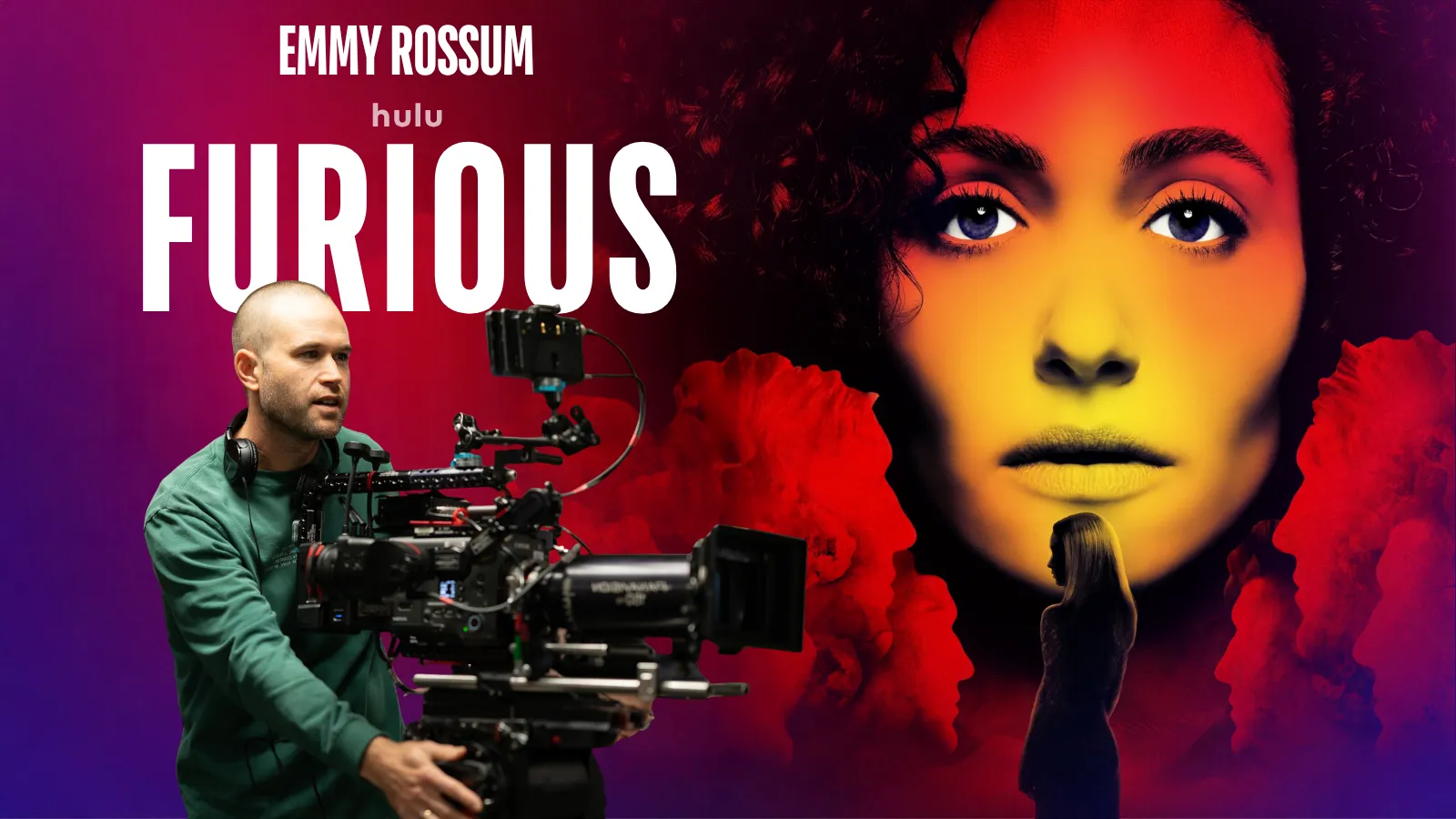
DP Doug Emmett on shooting the crime drama Furious
Furious DP Doug Emmett breaks down how the production team aligned on tone, lighting a penthouse with floor-to-ceiling windows, and creating a red-lit party scene. Podcast highlights include: -How the Furious team rehearsed their look-book pitches over Zoom before presenting to the studio. Every pitch got shorter and sharper, and the department heads began production aligned on the tone of the show. -How Emmett lit a 60th-floor penthouse of floor-to-ceiling windows that became a tricky house of mirrors once darkness fell. Taped-up light mats, low bounces and black rags kept the reflections out of frame, with no need to paint them out. -How a large Queens restaurant became a claustrophobic party scene. Emmett flooded the space with red light from old bulbs, mixed in cyan, and kept the camera tight on Alice because there weren't enough extras to shoot wide. -How he shot the show's two protagonists, Alice and Catherine. Emmett held a consistent focal length, kept close-ups in the 60 to 100mm range, and never went longer, so the audience stays inside the characters' space. See Furious streaming on Hulu. Find Doug Emmett: https://www.dougemmett.com/ Show rundown: 02:17 Close Focus 09:22-59:09 Interview with Doug Emmett 58:50 Short Ends 01:08:45 Credits The Cinematography Podcast website: www.camnoir.com YouTube: @TheCinematographyPodcast Facebook: @cinepod Instagram: @thecinepod Blue Sky: @thecinepod.bsky.social
Show notes
Cinematographer Doug Emmett had always wanted to shoot a gritty crime drama in New York. On Hulu’s Furious, he got his chance. Before the department heads pitched their ideas to the studio, they rehearsed with creator Liz Merriweather over Zoom. “I think my ideas were verbose and I had to drill down,” he says. “We got to rehearse these pitches with Liz. My pitch, and I think everyone’s pitches, got shorter and more specific and defined. And it really helped all of us as a team of department heads hone in on the specific tone and the mood of the show.”
Taxi Driver was an influence, for its grit, deep shadows and saturated reds and greens. “We didn’t have a DIT on set,” Emmet says. “So it was really important to me that we have just a few LUTs. I don’t want to get lost in the sauce with having lots of different LUTs for different locations or times a day.” Emmett limited himself to three LUTs: low, medium and high contrast.
Emmett shot Alice (Emmy Rossum) and Catherine (Lola Petticrew) on a consistent focal length, often the 16mm T-Series, with close-ups in the 60 to 100mm range. Any wider and faces warp, while longer than 100 would flatten out the characters. By day, Emmett chose bare, hard light for Catherine’s face, motivated by the sun. “I was excited about using really hard light that wasn’t diffused, smashing it into Catherine’s face,” he says. “And there were a few scenarios in which we did that. We felt motivated enough by the sun outside. We had pretty extreme ratio issues with the sunlight, so hitting her with a hard light ended up being a fun creative solve. She has beautiful skin, and she could take that hard light.”
Shooting in the first victim’s apartment was especially challenging. It was a real location in a 60th-floor penthouse with floor-to-ceiling windows. “Those windows become mirrors,” Emmett says. “Especially at night, it’s kind of like shooting in a big box of mirrors.” With one elevator and the trucks parked a mile away, there was no running back for any forgotten gear. The crew taped flat LED mats to the ceiling and ran cable out of frame. For a sofa scene, they lit from below with low bounces. “Anything at eye level, chances are you’re going to see it in one of these windows,” he explains. Black rags helped block the light and provide negative fill, with no VFX necessary to paint out reflections.
The location manager found a large Indian restaurant in Queens for the scenes that take place at Alice’s sister’s engagement party. “I think everyone kind of stood around and were like, are we nuts for choosing this location? Does this make any sense that there’s tapestries everywhere and chandeliers?” Emmett comments. Director Brian Kirk suggested they light the whole scene with red light. Replacing the chandelier bulbs with LEDs would have cost a fortune and probably wouldn’t have been bright enough, so the team hunted down old red incandescent bulbs. Production couldn’t fill the room with extras, so the camera stayed tight on Alice, which suited the scene. With red lighting dominating the space and cyan light at the edges, Emmett successfully created a feeling of claustrophobia in the space.