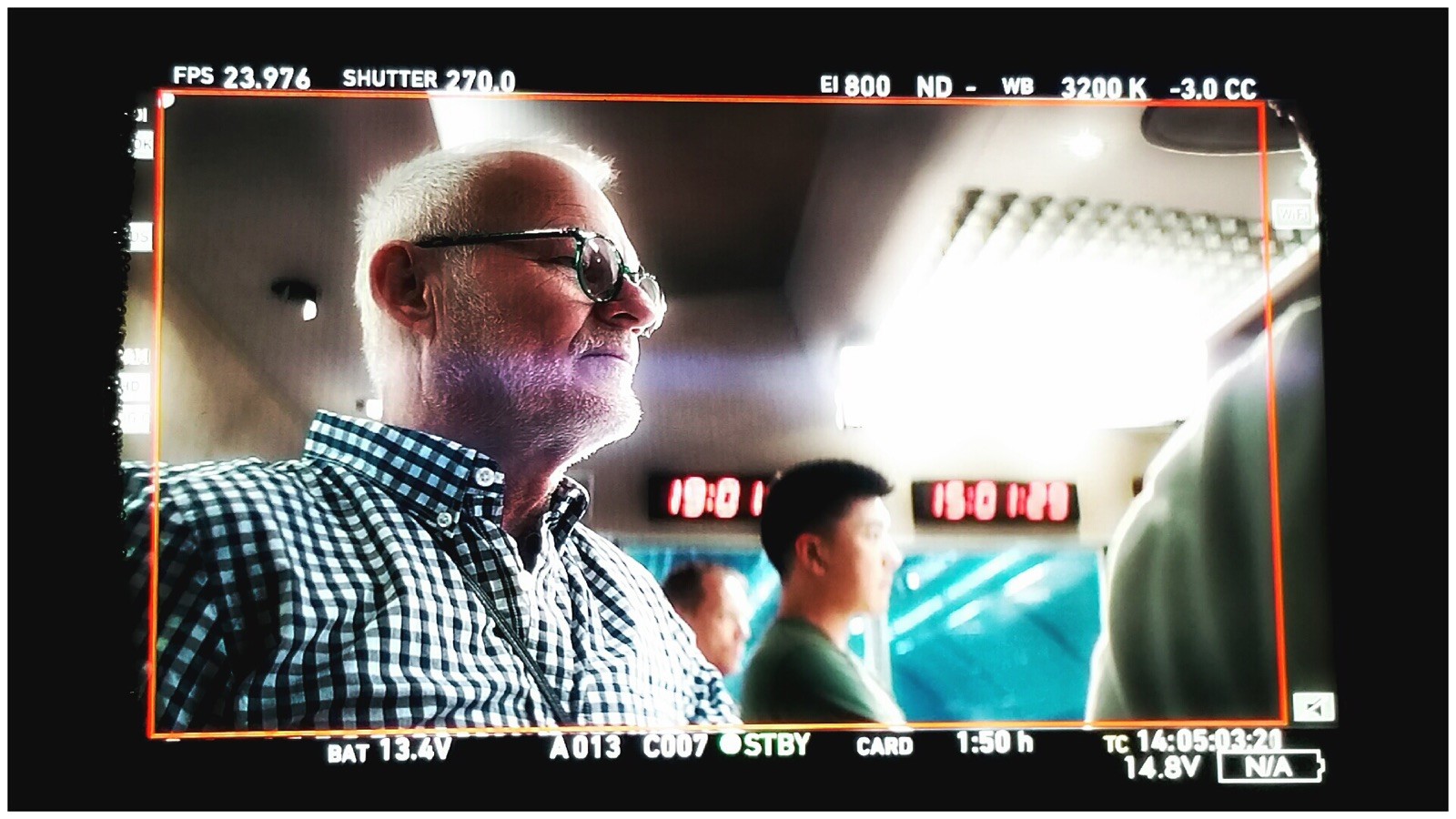
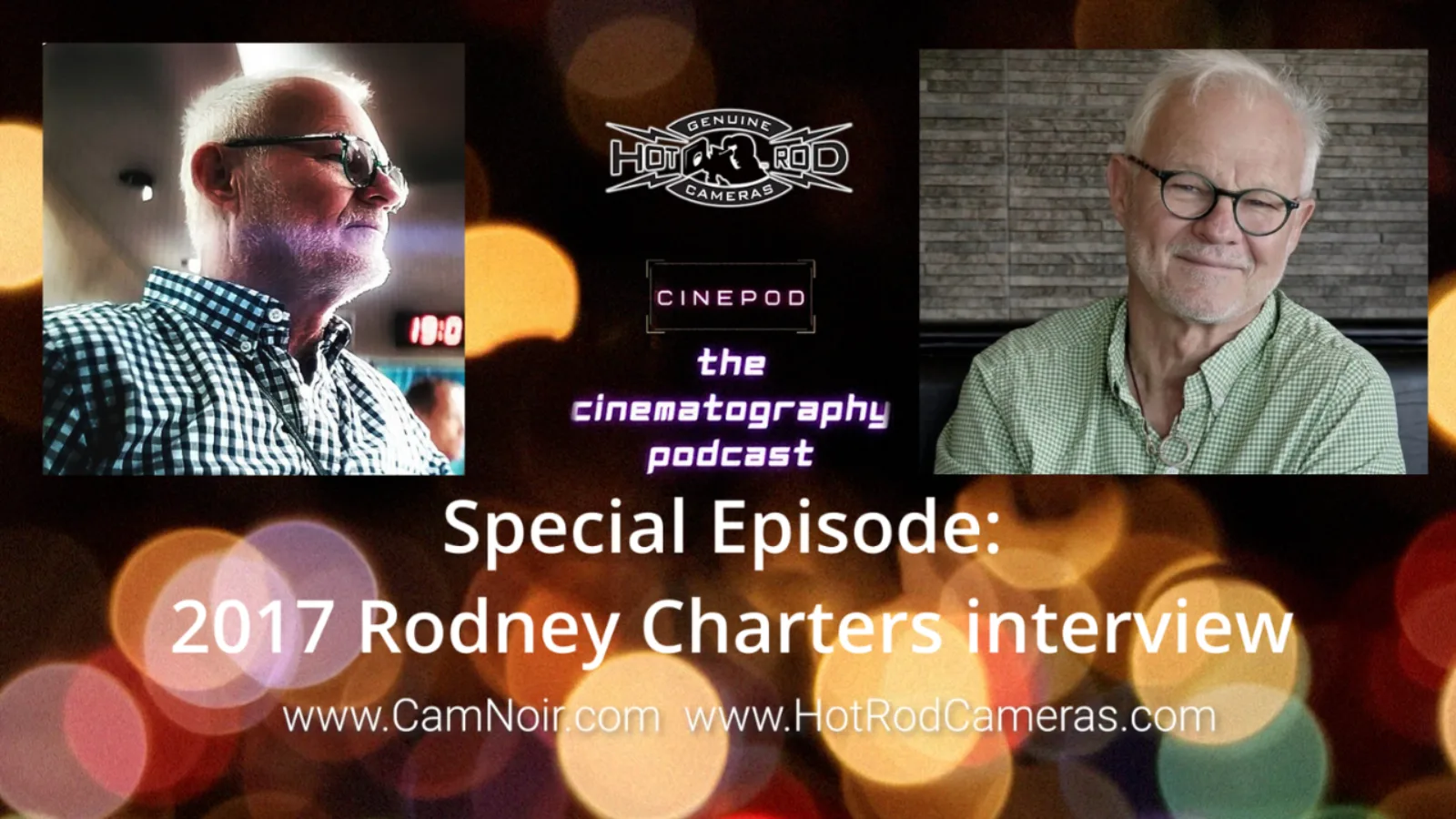
Special Episode: Remembering Rodney Charters, ASC, CSC, NZSC
Remembering cinematographer Rodney Charters, ASC, dp of 24, Sleepwalkers, and much more in this classic Cinepod conversation on craft, career, and lighting.
Show notes
We’re resharing a 2017 episode of our show with a heavy heart. Rodney Charters, ASC, CSC, NZSC passed away on September 13, 2026, at age 77. He was best known as the cinematographer behind the television series 24, as well as the shows Roswell and Shameless. Rodney also had decades of documentary and drama experience spanning New Zealand, Canada, and Hollywood.
In this episode, Rodney takes us all the way back: growing up in his father’s darkroom in New Plymouth and cutting his teeth as a sound recordist at the BBC. He learned to shoot on the fly as a documentary cameraman in 80 countries. Rodney talks candidly about the philosophy that shaped his camera work on 24, with full scenes shot in their entirety and actors given the freedom to find their own truth. From cheap secondhand fixtures to modern LED systems, Rodney perfected the craft of lighting, no matter the budget. It’s a wide-ranging, generous conversation with someone who genuinely loved this work until the end.
Illya’s personal note: Rodney took a particular interest in early days of Hot Rod Cameras and we became friends. I visited him on set for one of the final episodes of 24 and we worked together on several projects involving new technology for motion pictures and television. I was there in 2013 when he received a lifetime achievement award from the ASC. It was a wonderful evening where a thousand of his closest industry friends celebrated him.
Thanks for everything Rodney, you will be missed.
Transcript
Read full transcript
Special Episode: Remembering Rodney Charters, ASC, CSC, NZSC ILLYA FRIEDMAN: This is Cinepod, The Cinematography Podcast, a program about the art, craft and philosophy of the moving image presented by Hot Rod Cameras. We're resharing a 2017 episode of our show with a heavy heart. Rodney Charters, ASC, CSC, NZSC passed away on September 13, 2026, at age 77. He was best known as the cinematographer behind the television series 24, as well as the shows Roswell and Shameless. Rodney also had decades of documentary and drama experience spanning New Zealand, Canada, and Hollywood. In this episode, Rodney takes us all the way back: growing up in his father's darkroom in New Plymouth and cutting his teeth as a sound recordist at the BBC. He learned to shoot on the fly as a documentary cameraman in 80 countries. Rodney talks candidly about the philosophy that shaped his camera work on 24, with full scenes shot in their entirety and actors given the freedom to find their own truth. From cheap secondhand fixtures to modern LED systems, Rodney perfected the craft of lighting, no matter the budget. It's a wide-ranging, generous conversation with someone who genuinely loved this work until the end.
On a personal note, Rodney took a particular interest in early days of Hot Rod Cameras and we became friends. I visited him on set for one of the final episodes of 24 and we worked together on several projects involving new technology for motion pictures and television. I was there in 2013 when he received a lifetime achievement award from the ASC. It was a wonderful evening where a thousand of his closest industry friends celebrated him. Thanks for everything Rodney, you will be missed. ILLYA FRIEDMAN: Who's on the show this episode? BEN ROCK: Well, I couldn't be prouder. in my life that we got to talk to one of my favorite DPs on earth, Rodney Charters. ILLYA FRIEDMAN: Rodney is fantastic. And we could fill three episodes with Rodney. BEN ROCK: Rodney's not just an amazing DP. And not only is he somebody who I think kind of created a template that is all action television and a lot of action movies today. Like I feel like even if you watch the Bourne movies, I feel like they are a reference to the groundbreaking work that he did in like 2001 on 24. He took, he takes things to another level, but beyond that. Dude's just fascinating. When I grow up, I want to be Rodney Charters. ILLYA FRIEDMAN: And without further ado, Rodney Charters. BEN ROCK: I'm here with cinematographer Rodney Charters. Rodney, thank you so much for coming on. RODNEY CHARTERS: Thank you. BEN ROCK: Let's go back to the beginning of your story. While I became aware of you in the 90s with a certain horror movie, but also big time with 24, but looking at your bios and stuff, so you're originally from New Zealand, correct? RODNEY CHARTERS: Correct, yeah. BR: And your father was a photographer. RC: Yeah, he was a still photographer in a small town called New Plymouth, and he and his partner had met during the war when they were both Air Force phototechs in the South Pacific, in Guida Canal and other bases throughout the country, throughout Solomon Islands, about 35 different bases. And one of the things that I grew up that kind of influenced me was an album, a scrapbook album that he had put together after the war. of negatives that he had shot. The guys swimming in the pool in Hamburg Base and Guider Canal and Emerau and all the different bases that they were there. And unfortunately, as one never does when your father's getting old and you just never seem to have the time to sit down and say, hey, Deb, what did you do in the war, you know? But fortunately, one of his... buddies from that time has survived. And I did do an interview with him on a C300 and double system sound and tried to make a good job of it. But the reality is that you have to make it up. And this album was the starting place for me in my intervening years. I didn't care about it. And then after he passed, my brother said, oh, you better keep it. You need to be the archivist. And there's some 300 shots that were printed. Of course, the negatives were being very big. Some of them were 4x5 because they used the aerial plate cameras that he had access to. So some of them were quite beautiful, and he just kept the negatives and smuggled them back to New Zealand and printed them after the war, actually as part of his demob process and made this big album. So those images are part of my early childhood experience of documenting life, strange life. What are the kinds of images that you saw in there that really struck you? It was about the boys, you know, their dark room was a tent, and they had a great struggle keeping temperatures because it was in the Pacific, in the middle of the tropics. So he said that the American supplies were always dropped on the beach at night, and they would go down and find an air conditioning unit and put a big stencil on it saying Royal New Zealand Air Force. stencil over the American markings and then tell the Americans to deliver it to them. A shipment came in for us last night, right? And so they were quite enterprising, but they basically never wore clothes. There's just this historic picture of them, all the boys naked swimming in the lagoon, or they're all building their tent darkroom with nothing on, or just the big planks of wood in the appropriate places to preserve modesty. And it looked like a giant. Boy Scout camp. Because they were behind lines, they were with the air bases servicing. One of the tasks was to process gun camera footage. The 30-mil cannon cameras in the P-51s and so on would fire a frame every time a bullet went out of the gun. So basically you'd have this 50, they were probably about 6 feet long, and so they would be dunk tank. developed in a processing tank that was six or eight feet high. BR: Jesus. RC: And one of the stories that his partner told me only recently, funnily, and, you know, 75, 80 years later, was that my father Roy made quite a lot of money and actually bought our house in this small town, this big mansion that he had to hack his way through the old forest. An old woman had died, and this place was derelict during the war. And we lived in it, and it became a kind of... PTSD space for members of the core of his friends who had come back damaged from the war for whatever reasons and they were to hang out in our house and I remember them as a child, as a baby and then one of them said that I saved his life because he became, my mom gave me to him to take care of me. Daily, you know, bottle feed, whatever. And it kind of brought him back to life. And he went on for, had a great career in London as a musicologist and got into the business because he ended up being the guy in London. If you wanted music for your movies in the 50s, you would go to him and he would have all the new pressings from all the record companies in the world. And famous directors would go there to him and sit and listen to albums and make decisions about music that they'd like to use, classically based mostly, of course, in their movies. Anyhow, he told me this story. He said my father used to get booze. in New Zealand and the pilots would fly it up because that was the support area was out of New Zealand to the Solomons. And then he would hide it in the deep tank where they processed the gun camera and tie it on strings and then drop it in because this is brown soup. that just you couldn't see anything. And they made little hooks on the side of the tank with strings on them because no one ever found that they had hundreds of bottles of booze in these tanks. And he did quite well out of it apparently. BR: Did you meet him again like when you were in the film business and were you able to talk about that at all? RC: Well, my father, of course, was still working when I left New Zealand and went to the Royal College of Art in London, went to film school, but I used his camera to make the movie that got me into the college. a film called Film Exercise. That was my second year at an art school in Auckland and the university. And that opened the door for me. And I got into the film school. Tony Scott was a year ahead of me. And Stephen Goldblatt was a year ahead of me. I mean, there were great people that went to the school. We had very little footage, camera equipment. We had a couple of old eclair NPRs. Actually, they were quite special. We had some old ARRIs. BR: Like S cameras? RC: Yeah, 16 mil. There was no 35. But Tony went on to do quite lovely work with Stephen and other people. We made great films. I made a little documentary about a New Zealand couple that were living in London, black and white, and the New Zealand film people bought it. The television company bought it and broadcast it. BR: Oh, wow. RC: So it was a good training ground. And then I had worked summer relief. I had to go before a board, but I worked at the BBC as a sound dubbing recordist in an old studio out at Ealing, which is still Ealing Studios. I worked there a little recently, and it was kind of fun to go back and see the old recording room. It's gone now because literally I had a tiny space. I was the 35-mil mag recordist. BR: Oh, wow. RC: And I had this big mag stripe, 1,000-foot rolls. BR: So that means that you're taking like quarter -inch tape and dubbing it over to... RC: Well, I didn't ever do that. I simply was the guy who pressed record and made sure that the film ran through the gate and was in sync. So if we... There was a 10-minute roll. It wasn't rock and roll. You couldn't go back. You had to keep going forward. So if you made a mistake, you'd go back and start again. But I had a punch mark, and I had to set it up on the record head, and they would do this Selson interlock. It was a system where all the machines, all the playback, 35-mil mag stripe machines, would all lock to my recorder. And I was in another room on the other side of the property, and there was a mixer, and of course he had the picture up. And he would push go, and my recorder would, kick into gear with all the other playback decks old technology. BR: So like for for people because i think a lot of people who listen to this are probably from a time before editing on film. RC: Certainly. BR: So whatever was shot in the field had to be recorded onto audio tape that looked like 35mm film. RC: No, it was transferred. They were using Nagra's by then, quarter-inch reel-to-reel or a tape recorder. So they would record quarter-inch, and then you were in a facility that would take that and then turn that into basically audio tape that looked like 35, that was exactly like 35mm film so that it would run. parallel through like a flatbed or whatever. Prior to timecode, we had footage count that was stamped on the footage and stamped on the sound once it was synchronized. And I had a raw... and all of the sound tracks were coming back to me and they were being recorded on my deck. So I had to just make sure that nothing happened during that process and re-sync it every time we went back to the start. At that time, the BBC did have a rock and roll system based on an old Keller flatbed, which many film people still use the Keller system. I think probably they've changed over. But Spielberg, in these cutting films, still uses a Keller -style flatbed. And they would be just like a Steenbeck, a flatbed with different plates. And the 35-mil mag stripe would flow through those. And they'd have a bunch of them linked together with a hard drive. connection. So they would all roll together, but you could roll backwards with that. So that was the beginning to say, oh, we made a mistake. We'll roll back and we'll punch in just the way people did with multitrack. You punch in to go into record and then you start and continue your mix and you keep going that way. BR: But where you worked, they didn't have that system. RC: They didn't have it in Ealing, but I did do a spot at BBC Television Center where we had a rock and roll system. And in those days, much of the sound effects was spun in off discs. The BBC had a very, very elaborate disc library of 45 discs, small ones, and there'd be six gramophone playback records. That's right. And there'd be a great big pot and a needle drop, and they would cue it up and hit play and bring up the sound. So if you wanted gunfire or something, that's how they would do it. BR: I wouldn't last five minutes. Well, fascinating because... RCL They would make footsteps. They would make footsteps out of a rushing weir, a little water weir with a little bit of water tripping over. It would be a continuous sound. But they would watch the feet, and they would bring the pot up in time with the feet, and they would make the sound effects. I mean, our whole world is fake and make-believe. Yeah, yeah. And, you know, cut to the present. I'm actually having a lot of fun because I'm doing a show now which takes place in a different city in a different part of the world every week, and we're all doing it in Hollywood. And we're just cheating everything. So all those kind of old style techniques are coming back. Of course, we are using green screen and we're a digital shoot and we can do a lot better compositing. But all of these tricks go back to the early days when people found ways of emulating reality on a soundstage or in an actual film stage where you're doing filming. And you would cheat, you know. BR: That's incredible. RC: Yeah, I mean, the playback room in this suite was fast because it had 25, 35-mile mag-stripe machines. That is, as he says, they weigh 1,000 pounds each. My recorder weighed 1,000 pounds, and it was a vertical rack that was 7 feet tall. BR: And what do they do with all these? Did they archive any of that stuff? RC: No, it was all junked. I mean, I think you can probably get perfect tone, I think, was probably the company. They were Swiss. They were beautifully made. Beautifully made. And the Keller flatbeds was the sound-only version of the chem. BR: Oh, okay. So you had a chem at one end playing picture, and it was into a... There had to be a plumber cone tube recording that image that made the tape, right? RC: Yeah. BR: Because it all went to tape to go to air. RC: Yeah, yeah. And, I mean, the amazing thing is, though, this was a show called The World Tonight or something that I was working on just briefly as an assistant. And it was an hour long, and they would record it in two... of 30 minutes each and they would have a guy come over and take from put it in a motorcycle run downstairs literally and motorcycle about a mile across this complex at bbc television center to lace it up and make it go to air and while they were playing the first reel we were still dubbing the second reel that's how scary that got BR: There's madness. RC: So hence the whole gram swinging thing. Those guys were so adept at popping in all that background stuff that nobody had time to find. And it was fast. It was really fast. Because they would preset a bunch of discs. And you could see them very skilled at flipping these discs back and forth, needle drive. BR: They're like DJs. They're like modern day DJs. RC: Yeah. Yeah. It was really fun. BR: That's incredible. So, so how did, well, first of all, I kind of want to hear a little bit more about starting out in New Zealand and making films in New Zealand. What year about would this be? RC: There'd be 67. Well, I left in 68. So I went to the film, made it into a film festival in Sydney in 67. BR: So mid 60s, like what, what is the filmmaking atmosphere like in New Zealand back then? RC: Well, there wasn't none really. There were some people making—the government had a publicity wing called the Film Board, and you could join that. It was very similar to the Canadian Film Board out of Montreal, and they made tourist films. One of their alumni was a guy called Brian Brake, who became a very famous time-life photographer and was a founding member of Magnum, the Stills. group that's founded out of paris and he and my father knew each other because they would come through and photograph taranaki for publicity and my father and my mother i found i went into a museum recently and i'm standing staring at this picture and i realized this is my mom and dad walking around the maori pa site and even more extraordinary is There's pictures of me as a child in this movie. It was about Taranaki, the province where New Plymouth is, and that was really strangely weird. But the cameramen, of course, they would come to my dad's studio as a kind of stopping place because he knew the best spots to film the mountain. We have a Fuji-style mountain, which is perpetual snow, but during the winter it would get... to about 3,000 feet. And it's 9,000, 8,500 feet high. So it was quite spectacular. And where the valleys and the cows and the trees and where was the best place to shoot this, my father knew because they were always traveling around doing weddings. They were driving from A to B. They would stop and take a picture of that particular spot. So they would tell these cinematographers. And then on this occasion, to go to a Maori burial, actually a fortification on the top of a hill with the truncated ramparts where they put up the big stakes and so on, you can still see all of that in place from 150 years ago. And my mom and dad are walking up the side of this and then walking around, and the voiceover talks about it being a parasite in the mountains in the background. So he was instrumental in having... with these cinematographers. So, of course, he early on and his partner said, we've got to have a camera. And he made quite a lot of documentaries. I was in many of them, 8mm, Super 8. Yeah. They were about, well, the back story is that when the return services came back, the airmen and so on, soldiers to New Zealand, the government allowed them to get free land in the interior, deep in the interior that was fully bush covered. But their challenge was they had to get to it. So they'd had to build their own roads through the bush, felling trees, selling the timber, stripping the land, and then planting grass. So that process was years in the making. But as a child, I remember carrying the detonators for the blasting. in a little wooden box with shavings in it. I was the guy that they would come to. And they had one of these Husqvarna drills with an eight-foot drill bit that was the core size of a stick of gelignite. And, of course, these guys were all out of the war, so there was nothing to them, this kind of munition stuff. And we'd drill into the side of this. It was popper. clay it was called it was kind of quasi limestone it was relatively soft but you needed to blow it out to get the bulldozer in and start cutting through the cliffs yeah and so they would they fill the trees then they come along with the bulldozer and they get to a point where they needed to blast they drill into the side they put six sticks of dynamite in i remember and then they would put in my detonator into the last stick and shove it in and it had about a foot slow fuse on it when they would flick out their bicks and they'd light it and we'd all run for cover and the thing would blow, and then we'd go back in with the bulldozer. BR: That's insane. RC: I haven't found these movies. I know where they are, but they need to be transferred. I don't know whether they'll play anymore, but they were quite fascinating. BR: Oh, my God. You've got to get those. RC: Well, it got me going into, oh, because we would see them, and then my dad would get movies if there was a birthday party. There was a ballroom, a small, modest ballroom in this house, and he'd cut a projector port up the top and put glass in, put an old 16-bell and howl up there, and he would play movies if I had a birthday party, and all the kids would come, and he'd get the young rascals, and he'd get all these Hollywood 16 -mill movies, and we'd watch them. And he was a member of the society, the film society, and they would get... more obscure European films that wouldn't make it into the theater. I mean, amazingly, in that time, New Zealand had the second highest standard of living in the world in the 50s and 60s, right behind America. And we had five cinemas in our town, so people went to the movies. This is all before television. Television didn't arrive in our town until the late 70s. BR: Really? RC: Well, no, I'm saying it would be late 60s. But I remember watching Gunsmoke with my dad and the Westerner. Yeah. But loved what was going on with all of that and thought that... was making documentaries, but he did make a little movie about me. And so I played a little kid who gets his trains coming and my legs stuck in the trestle bridge and there was danger, you know, called The White Goat. And so that was an exposure to me of behind the scenes, in front of the camera, 16 mil Bolex. So I borrowed that to make a movie. And the movie... was this kind of rock video thing, early, early days, which may be online soon. I have to find out where that is. And it got me into the college in London. So then I just left and never came back, basically. But this was well before Peter Jackson, so there was really nothing going on. And only last year did I come back to New Zealand to work. I worked on an MTV series called The Shannara Chronicles. They had me down for a... A couple of episodes and a bunch of other stuff. Big fantasy series. Alexa, anamorphic, sender extraction. Beautiful, lots of fabulous sweater, enhanced prosthetic makeup. BR: Oh, I bet. RC: $50,000 heads for villains and so on and castles and werewolves. BR: Sounds like a lot of fun. A lot of fun. Did you get to like blow up any mountains just for old time's sake? RC: No, no, no, no, no. But of course, 24 did give me that feeling because we blew up a lot on 24. You blew up a whole lot on 24. Okay, so you're working as a re-recording mixer or... It was a summer relief job. They had 54 crews in London at the BBC at the time I was there, and they'd send them all the way for the summer. They would take their summer holidays, so they would hire freelance people to come in and fill in, and that's what I did at BBC Ealing. BR: Was that like your first big... RC: It was my first official film job, really. I was paid, and I got into the union, which at that time was very tight. You couldn't work unless you were in the union. Subsequently, rocked videos, funnily enough. Blew that out of the water because the kids just weren't going to play that game. That's happening now on YouTube. Yeah. BR: So how do you transition from that into shooting? RC: Well, it was just a temporary job. I did have the card, so I worked on commercials with both Tony. I did his first commercial, bless his heart. It was a Ribena commercial. And I was the third guy on the sound crew. Another guy in our... our school became a mixer because nobody was available and he showed up with the Niagara from the school and they gave him that job. BR: A lot of people get a career that way. RC: Yeah. BR: At this point, I guess my big question is were you focused on you wanted you wanted to shoot or did you know what you wanted to do yet RC: no I mean I I understood documentary in the concept of that I made a quasi drama film but not really and there was no clear path in the early stages of our film scores to how to get into drama you were on the outside because we didn't have union accreditation and we were not able to get into the union The British Film School started soon after in my final year, and they were locked in a deal with the union, so if you graduated from there, you could work. So I suppose I wandered, and what happened was I made a movie. for the Baha'is about seals and crafts. They came to London, and I knew them as Baha'is, and so I made a movie we shot at the Roundhouse and a bunch of stuff around London, and then I took it to the States to sell it, and people wanted slight changes, so I had to find money to make the changes. It was 16 mil films, still cost money. BR: So is this a documentary? RC: It was a documentary about their being in London. BR: And when you said you made it, you directed it? You directed it and shot it? RC: I directed and cut it. Okay. And shot it. So now I'm in America. BR: So you've kind of one -man banded your way through it. RC: Well, yes. I mean, certainly the first film I made was absolutely that because nobody else knew. And I actually cut film 16 mil with my dad. He would do with a cement splice and lose a frame. And then they would get the finished film mag -striped, and then they would lay a track back on it. It was the early primitive days. And I knew about double system. Because a very early film, I had a great tutor, not at the Royal College so much, but at the school in Auckland. And he had been also a time-life photographer. And his last great project was in China in the 50s. In 57, he was kicked out. But he spent three months photographing in China, black and white, of course. Amazing stuff. And he introduced me to the British film unit. the transport film department and they had a film that was called snow which was a you can find it online it's amazingly well cut a montage of trains clearing snow line lines are covered in snow and it's all cut to a very percussiony drum beat and uh so i realized that the bed in my rock video film wanted that kind of integration and uh I talked the drummer of this band into doing various tracks for me, and then we wrote music accordingly that I could then utilize in the edit. And I was cutting double system. But when I first started the first piece of 16mm, I cut it with a razor blade, and I joined it with tape, and I punched out the holes with something sharp that I could find so that we'd go through the gate on the projector. Oh, wow. And hope it didn't jam. Right. And I didn't know about separate mag stripe at that point. Of course, today, people don't have an understanding of the physicality that you had to do. But there were many things about cutting film when you had pulled your strips out and you would hang them on pins in a bag. And you could hold a handful of 50 shots in your hand and up against a white... background, you could flick through and see the image, and you knew which take you wanted, and you would pull it out. Whereas now, you have to go in a linear fashion through a reel to look, even in software versions. It's only in very, very recent times now with the software allowing you to look at a bin and see the head clip. Yeah, yeah. But you have to click it to play it. It's not quite the same, because a lot of people would... film through their fingers, and you could tell what was happening. You got used to doing that. BR: I know. When I was in film school, we had those, and I always remember the experience of turning the bin upside down to find those four frames. RC: Yes, yes, it would drive you crazy. My daughter tells a very funny story. I let her play with the trim trims that were in the base, and she would make up these tiny movies that were two frames, three frames long. and played them. She has a fond memory of that. She has a movie on iTunes now, so that taught her. She was hooked. BR: That's cool. RC: But so many stories from that time that they no longer have any relevance to anybody. It's just there was a history of it all. Nowadays, everything's nonlinear, and I'm working with LUTs, and I control a camera with LUTs. I see exactly what the final image is. I record it on my desktop. I have Iris control. I mean, there isn't anything that I can't do with a modern cinematography setup. BR: Do you feel like there's anything lost because of that, or do you feel like, as I've been following your career, again, for probably at least 15, 20 years, you've always seemed to be someone who would gravitate towards new technology when it came out, and you would use it. RC: Well, part is job preservation. Time marches on, the technology changes, and those who adopt move on. Those who don't... get left behind yeah it's very simple so very early on for some reason i i had a transistors were in my blood when i first saw valves i made early valve systems and then called my first transistor radio and that took me into photoshop Version 2 .1, and I stayed with Photoshop forever because it allowed me to manipulate imagery, allowed me to manipulate stills, and then subsequently, and now we have Resolve. Any cinematographer who doesn't understand Resolve is losing a large part of what we have to do. We do two things. We both expose. We control the lighting as part of that package on set. And the second thing is we should have control of our image in post. Yeah. the ability to go and sit with a timer. And only recently was I reminded of that on this lovely picture that's coming out next year called Going in Style with, shameless plug, Morgan Freeman, Michael Caine, and Alan Archer. Shameless plug, that's awesome that you got to work with those guys. It was an extraordinary experience. So we did this with Zach Braff last summer in New York, but six months later, I got to sit with a timer at Photocam. Costas, and he and I spent 100 or so hours going through the mover meticulously with resolve, putting in shadows where I was unable to do it, taking things back, bringing things up, tracking Morgan Freeman's face quite frequently because in contrast to Michael Caine, who was quite a white Englishman, there was less light that wound up in Morgan's face. I mean, he was still getting the light, but he absorbed more of it. We had to track him and bring him out occasionally to complement the frame and allow for the comedic possibilities, even though I thought the frames were great. Zach said, we need to see him a little better than that, so we have to bring him out. A credit to the Alexa RAW system, absolutely painless being able to bring somebody up two stops if necessary without noise. It's spectacularly powerful. And, you know, that's one of the big challenges I have with some of the other cameras out there, that they don't have that level of dynamic range. You can't go five stops down or five stops over and still bring it back to neutral. And that, for me, is the stamp of a good chipset. BR: Yeah, well, like you always hear about in Mad Max Fury Road, how for the day for night stuff, they just underexposed everything, right? RC: Yeah, yeah. It's insane, you know, and it goes against conventional wisdom, and yet it looks beautiful. Yeah. Well, those are tools that the cinematographer should be responsible for. And right through to kissing the final print. And that was, of course, on a feature, people respect that. And that was a wonderful thing about it. Other series that I did last year called The Last Ship, the production super... didn't allow me to even sit with the color timer. I was never present for any of that. And, you know, Michael Bay's production, okay, fine, he has his look and everything, but really the respect due should have allowed me to be there at those sessions. I should have been notified when they were there and so on. So I feel that's a system in this digital age which is losing touch with the realities of the importance of cinematographers. And, of course, one of the problems is... everybody being able to see what you do, there's no mystery anymore. And the cinematographer is losing control of his ability to create his look and carry that through to the end. It's so much easier now for... somebody in post to say, oh, I think we'll make this brighter. This happened in the Shannara Chronicles. They devastated it. The editors got in there and the producers got in there and they really made the color that we had done on set with a dit, I might add, doing from raw, making the look on set. It never made it past editorial and it certainly didn't make it into the final color. So, you know, these things, obviously we work for people, but at some point... Certainly in the old days when you were hired as a cinematographer, it was because they wanted your look and there was respect there. And very seldom do you hear those kind of divisive situations where people were let go or people took over. I will let the person remain nameless, but I know a cinematographer who shot a feature for a director. The director then learned how to use Resolve and relit the whole thing in post without the cinematographer. And when the cinematographer saw it, they were... know not happy because like every choice they made had been I mean like down to the point of tracking power windows and you know like in dolly shots changing the way foreground and background interacted with one another absolutely all of that's possible and it's both a blessing and a curse. BR: Let me ask you a little bit. I'm sure that we'll get a little bit more into your background, but I feel like your work has kind of a distinctive look. And I'm sure that, you know, you'll go work on a show that where there isn't a distinctive look. But even like I was looking at the reel that you posted online. So maybe that's biased because it's the stuff you chose to put forward. But I've been watching your stuff for years. And I do think that there's a certain craftsmanship to it. There's a certain intentional use of overexposure in certain parts of the frame. There's always something interesting in foreground, middle ground and background. There's like a full story. happening and I just wonder like do you have a way that you define your own look or do you just want to dive in and give people what they ask for because obviously after doing it as long as you have you're just going to make a series of decisions based on your experience that are going to be your look. RC: well starting out professional life when I finally did get to shoot I cut for a year I shot a documentary in South America for six months then I cut it and on the strength of that The network in Toronto gave me a cutting job. So I cut for almost two years with a six-plate Steenbeck. Wow. Original video news film where there was no negative. Then when you made a cut... BR: Oh, just shot on reversal? RC: Yep. BR: Oh, dear. RC: And when you made a cut, you couldn't put it back together. So you would always cut long and gradually inching towards it. But that really taught me a lot about... Having to make a commitment to time and planning because everything was cut to size and timing. I think the whole process of editorial is as important. for a cinematographer to understand, it's sort of vital that you do cut your own stuff, at least to get it out of your system to a point where you say, no, I have to lose this. You can't fall in love with it. It doesn't advance the story, so chop, it's gone, you know? Yeah. So my documentary experience I did about 20 years out of Toronto, all over the world, 80 countries. It was fun. I don't think I could do it anymore, but, you know, hauling that. 200 pounds of stuff around. BR: So you were traveling with a Steenbeck to those countries? RC: No, no, no, no. I just cut for two years for them, but they then gave me a camera job. Oh, oh. I finally got a camera job. I'm sorry. So for 20 years, I shot for them. And it was 16 mil, Ari. I didn't have, I had an ACL Eclair. I never had an Aton. I would have liked an Aton. I was surrounded by them, arguably the best of the 16mm cameras. They shot beautiful if you're on your shoulder. I used to rent that on 24 when we needed to go handheld. We'd rent, I suppose, what was for Nelope, but there was a 35mm equivalent of the Aton. because it just sat on your shoulder very well and had that lovely wooden handle, and you could run with it, and it felt great on the shoulder, basically just sat there. But I was with an Araflex, well, I did have a BL for a while, dreadful 16-mil, little box. Big and loud. Yeah, it didn't have a blimp. It was loud, 400-foot max. The school had one. That's how I started with that. I don't know a single sound guy who ever liked the BL. No. The BL-35 is probably more what you're thinking of. You kind of, yeah, that thing was noisy. You had to be very careful. You used a lot of nose grease when you were putting it through the gate, so just a little bit of fluid there. It was more silent with that. Mag chatter, having to deal with all those things. Yeah, I had an SR1, and then I had an SR2, and I had a Super 16 gate for it, which had been in the bottom of the Mediterranean. I managed to get very cheaply out of London. One of these technicians pulled one and said, do you want this? And I said, oh, yeah, I want that. You're like pulling fish skeletons out of it. Well, it was a little crusty on the inside, you could tell. It had been in the bottom of the ocean for a bit. But that was my workhorse, and that and two mags carried on the plane, and then a bunch of film back. Those are great cameras. It was a good, solid workhorse camera. And I had various zooms, 10 to 100, 9557, which was a nice, short, wide zoom. But you taught yourself how to tell a story with a camera. If you're rolling continuously and it was something you couldn't control, you would say, okay, well, this feels like a master, and now I can zoom in and get a little tighter on this, but now I've got to flip over to the other side to quietly move around. And you keep rolling the whole time because you didn't want to sink because you didn't want it to retract. You were trying to do fly on the wall. Some of my greatest moments were those kind of things where... there was real drama going on and tension in the room and people just ignored you and you just managed to get all the angles and so you could cut it together. But the training as an editor helped because I would always go crazy if people didn't give me the cutaways at the right time and you couldn't structure it. So carrying that on, that helped me a lot with 24. And I had done one story in Northern Ireland a week after Bloody Sunday where we were driven. We were blindfolded and driven around by the IRA and then taken to the back of a pub at night into the back room where the divisional head of the IRA was there. And we pulled his turtleneck sweater up over his face and we interviewed him. I was not shooting then. I was the sound guy on that. But that experience sort of helped me a lot when we're thinking about 24 and how do people react under terrorist conditions. And of course, sadly, it's more the norm than the... nowadays and i don't think it's going to go away they're starting 24 up again and i don't know whether there's quite the appetite for it at the time it was a fundamentally an educational tool to both excite and terrorize people around the world because we sold it extraordinarily widely around the world people liked that palpable tension but also they came away thinking about terrorism in a different way. BR: well you know before we even get into 24 i have a couple of questions that I would love to ask you that I kind of ask everyone. And now that I sort of have an understanding of your background from your point of view, the big question that I ask everybody is where do you come from? Do you come from lighting? Like when I hand you a script and you read a script, do you see it in terms of the way you're going to light it or do you see it in terms of composition? So in other words, are you creating an image and then finding the composition within that lit area or are you creating a composition? And I have a theory about you, but I want to hear your opinion of that. RC: Well, I was, of course, trained in London, so I tend to lean towards the English tradition of a lighting cameraman. So I would first say that I'm affected by light first and how you might position light to affect the tone of the story of the scene, augment, contrast, so on. And then the compositional part of it is not so high on my list because I feel, that if I'm going to hire operators to compose and execute for me, then I don't feel that they're part of the team unless they're contributing. So I give them freedom to contribute. So that means I primarily control the overall finished product, but I'm eager to seek a contribution from my operators about how they feel it should be. You know, I can nudge them to say, look, lead a little more here or follow this frame but keeping the old adage from documentary days follow the puck it's about what's important in the story and making sure that you are positioning the audience to see what you want them to see at the time that you want them to see it light is obviously a major factor in that but composition is sometimes equally as important But I have less control over that than I do over the lighting. Of course, I share the lighting responsibility with my gaffer. And so that's a shared experience in a normal feature environment after being involved in prep, working with production designer, pre-formulating a plan. It all kind of hangs in the balance until you see the blocking, you see the read-through, you see the actors block it, and you're in a space provided by the production designer, augmented or taken from reality. And then it's your job to say, well, we're in a supermarket, guys. It has to feel like a supermarket, and there's only one way you light a supermarket. Unless you're near the windows, you can tend to bring... know hard light in and maybe it reaches the tellers in the front yeah at their waists or at the teller machine and you can cheat those kind of things but generally people i think are thrown by light which is supernatural unless you're doing a fantasy and you can get away with anything so on this shanara series we used a lot of xenons old style xenons with mirrors and so on and cut vigorous narrow shafts of brilliant light blue into spaces that were not meant to have light, you know? And we just said, well, fuck it, you know, who cares? It's like, it was great. And so I like that you can do that when you shift gears tonally about what the content of the story is, the genre of the story. Obviously, horror story really thrives on not seeing everything in the frame at the same time. Always having a portion of the frame be dark. It makes it a better product if you're using harder light and so that you can always go back to the traditions of the 30s and 40s where everything was a 5K and a 10er for now and very aggressive cutting so that you could force large chunks of the frame into darkness simply by putting a cutter in and it wouldn't go anywhere. A lot of what we're obliged to shoot in modern drama involves white rooms. And they are the death knell to a cinematographer's control of contrast. Yeah. So you're continually trying to say, well, I can't do a 180 in this room because I need to put black up on that wall. Otherwise, I have no contrast. And it becomes very bland and flat and boring. Not that bland and flat and boring doesn't have its moments. And certainly, comedy leads you in that direction occasionally. You know, in this movie last year, I had so much fun with Morgan Freeman's face, with Michael Caine's face, and Alan Arkin. I mean, there was just... And then I had Anne Margaret, bless her heart, to deal with. Oh, wow. Who was 73. And I got a lovely, lovely voicemail back from her. I was in Kuwait for reasons. Like you do. I didn't... answer the phone and so it went to voicemail and she left this beautiful message saying how much she loved how she was lit in the movie and it was really a question of saying well she's 73 and we have to be careful here and so on I think in the end there was a tiny bit of digital help given but there were whole scenes where there was none and it was all up to me so I felt pretty good about that we're in the business as cinematographers of creating a safe haven for the actors, an environment within which they can perform. They are assisted, even though it's subtle, by the tone of the light that they're performing in. And I think sometimes you have to be careful that you don't broadly wash everything in a way that they don't get a sense of, oh my God, if I don't hit that light, my knife will not be seen. Or this dagger in this compromising moment. And how do I hold it and so on. And I like older actors because they often have had stage performance. They know how to rock into a key light because they feel it on their face. And you really appreciate that with the old timers because they just have been there and they know they get it. So many performers, modern performers today, don't school themselves in those older crafts. And I think that's a shame because... how to help you by finding your light when I gave it to you. I actually exploded on a guy in New Zealand because local Maori boy, lovely chap and a lovely actor, but he was a little bit out of control of himself and he was on a horse. And I put a cross light on him to give him a nice strong cross key, like 90 degree cross key. And he rode into this position and took the light and then for absolutely no reason moved his horse forward a few more steps and went completely out of it because he was grandstanding the other actor and he wanted to be the one who was in the front of the frame. Oops. And I screamed at him. I said, don't you fucking do that again to me because I put the light there for you for that moment and you have to be cognizant of it and we're... partnership here and when you do that to me all bets are off you went into darkness and I'm it's nothing I can do about it and I said don't tell me you didn't know how to ride the horse because you backed right back into that market and you totally had horse control there was no question you knew what you were doing but please it's a deal between us I give you light you take it if you don't want to take it that's your problem but it's just going to make us both look bad And of course, it applies more to hard light than soft. Soft is a tricky thing because everyone's going to Kino's LED Kino-based lighting now. And I've fallen in love with Quasar Sciences system of... We're fluorescent tube structures put into KenoFlow fixtures because they're core-plast, they're light. You stick them anywhere and they come to the size. BR: Yeah, Ilya was telling me about this. I haven't tried them out yet. RC: They're fantastic. They're taking over. Many people make very sophisticated lighting that's LED-based, and they spend a lot of money, particularly with the sky panels and so on. And they're RGB, and that's wonderful. And they have very good color temperature control, very high CRI. But they're very heavy, and they have a big ballast. And at some point you say, well, the Quasar guy's approach is to replicate a tube as efficiently as you can, give it a very high CRI, make it color switchable. And now their version's a variable color control from 2700 to 6K Kelvin. And put them in whatever you want. You stick them in a fat boy that has six two-footers in it. It's basically a kind of a square. You add silk or your diffusion or your don't. You can do whatever you like. And then as long as you have some good Fresnels around to augment that, if you want a sharp cut, there's nothing like a Fresnel or a Dado. It cuts very well. And Dado have a very fine light now, which is 90 watts of LED, very low power, maintained, very good color temperature, but that has a ballast. So there are other people coming to market with versions that don't have a ballast. They're a little cheaper. I personally think the best light out there, if you're just starting out, is a par. A rock and roll par. You can pick them up for nothing. Secondhand rock and roll shows. They're less than 50 bucks new. Wow. And there's a par 38 bulb, par 64 bulb in it. And you can get a fire starter all the way through to a flood. And that's a lovely light because you take a narrow beam, one of those, into any room and just hit the corner of the wall and you get beautiful refractive light. And as you pan it around the room, you can see a change in its quality. And then all you need if somebody is lighting and they're not moving around a lot, you just bring in some negative fill and you're off to the races, you know. And the beauty of the modern cameras is you can see exactly what you're doing. You actually see exactly what you're doing. Okay, guys, can you change to 2,700 Kelvin on the camera for me? Oh, okay. Now take it to 6,000. Let me have a look at that, you know. Oh, interesting. Now can we change the color on the LEDs? Well, flick those over. And ultimately, all of that will be on the palm of your hand in your laptop, your phone rather. You can control it personally. But right now I have a board controller who runs around behind me with a laptop and does all of that. We have 500 or 600 lights that are under digital control. BR: Because I'm a giant horror nerd, I wanted to talk to you a little bit about working with Mick Garris on Sleepwalkers. I think, to my knowledge, that's maybe the first horror movie that ever used CGI. That was one of the first theatrical features you had shot, correct? RC: Yes, I had done a couple before that, but we had done Psycho 4 prequel. together. Mick Garris picked me up to do that. And it was wonderful to be based out of Toronto and then gradually more and more Americans would come up and they would hear about you and then they would ask you to go do things. And we went to Orlando to shoot. BR: Wait a minute. So this is crazy because I'm from Orlando, Florida. So I was in high school. when they were building Universal Studios Florida, and I remember driving down I-4 and seeing the Psycho House and being like, holy shit, there it is. Movies are coming to Orlando, and for the longest time we had this mistaken belief that Orlando was going to be a mecca for filmmaking, and in fact, Universal had basically funded a film school. I went to two different film schools, and the first one I went to, they had funded just to get a crew base, just to have grips who knew how to open up a C-stand. That's still a problem to this day when you run out of crew. It didn't occur to me that Psycho 4 was the one that was shot in Orlando. RC: Yeah, it was Psycho 4. And we were in a big new stage there. It was a beautiful stage. And they brought, they trucked the Psycho House in for us from storage and reassembled it in the stage. It was up there forever. We shot there. I shot a student film that used the Psycho House. Well, we did use the exterior as well. But you remember, because you know it, the proximity to the rock. or some cafe was ridiculously close. Hard Rock. Hard Rock was right there. Yeah, yeah. And it was very, very difficult to frame around that. This is pre-digital, so we couldn't do cropping and reframing and so on. So we had a bit of a struggle lighting it and everything. But, yeah, that was it, and we set it on fire. We set it on fire. BR: You kind of shot the first, like, big movie that got shot in Orlando under that regime. I mean, other movies have been made there. That was wonderful. I'm sorry. I should have known. It didn't even occur to me that 4 was the one that they had built that for. RC: Yeah. It's released on a compilation, I think, now. It's actually not a bad movie. BR: No, it's not. I remember seeking it out at the time because... RC: I already got a couple of images on it in my reel because... RC: Oh, yeah, because you got Anthony Perkins on there. RC: That's right. BR: But, I mean, I remember when it came out going out of my way to see it because I don't think it got like a humongous distribution. RC: No, no, no, it didn't. And it primarily was like a television movie. Yeah. But we did the right thing by it. And so Mick got Sleepwalkers after that. Yeah. And we shot that at Warner Brothers, the old Warner Brothers. Although many things haven't changed. The city square, we had 100 cats running through the city square. which was done by second unit DP and director. I'm glad I didn't have to deal with the cats at that level. Oh, dear. But we had 50 or so at a time outside the house. Now long gone. I think it was the old Walden house. And we shot there, and then we shot on stages, of course, for a big build. That was the last time I used an arc, because the lighting crew, lovely guys I got from Kovacs. Laszlo Kovac's team, both grip and electric, came to me intact because I didn't know anybody. BR: Did you know Laszlo? RC: I didn't, but I went out to meet him. He was shooting in Griffith Park, one doing night work, towing some vehicle in the night. And he was just lovely. He said, Doc, take them all. I don't have a movie coming up. Just use the boys. And so I got a great team. And they were really lovely, and they cracked up some old arcs for me. Nice. white Flame arcs to use in the interior of the house. It broke out into a garden at the back of the house, and we just needed more punch for daylight. BR: So on Sleepwalkers, again, that was one of the first horror movies I remember that utilized CGI. Today you would just shoot a bunch of plates and figure it out later, but back then I assume it was a lot more complicated. RC: It was a big deal. Mick wanted all these shots to be moving transitions. Well, the car would change. It changed shape. And it was great. We used a track-based system based on a peewee. The peewee was dragged along by a tooth belt that was under motion control. Oh, wow. And so we could repeat it. And the head was a motion control head. I don't know whose head it was, but we basically put it through its move and then lock it, and then we'd play back accurately after that. So it would just repeat the same identical move. Repeat the same move. We would do it with the first car, put the other car in, and do it with the second car, and then they'd make the transition wherever they wanted to have it creep into changing its shape and its color. And there's that one iconic shot where the face turns into the cat face. BR: Yes, yes, yes. It's kind of an early morph for a movie. RC: It was. We did that on stage. It wasn't as successful. The background plates we shot out on Potrero Road in Happy Valley. It was supposed to be Virginia or somewhere, I forget. I always think botanists must watch movies. be like, that plant wouldn't be in Virginia. I know. Well, they're so brazen about it. There's a series called Roadies on right now, and they shot downtown in the Bonaventure Hotel with the elevators on the outside. It's so distinctive. It's so distinctive, and they're supposed to be in Denver. BR: I feel like I could spend a whole day just asking you about 24, because 24, I feel... that 24 and specifically the cinematography in 24 kind of changed television i first heard of 24 because i knew krishna rao do you know krishna yeah and krishna told me he had been on he had done a camera or b camera i think on the first ever episode and i don't believe you shot the pilot or did? RC: i didn't shoot the pilot peter levy shot the pilot with stephen hopkins BR: so uh but krishna he didn't want to do the series funnily enough But do you come on right after the pilot? RC: Yeah, I did episode two, and we had to reshoot some of episode one because of 9-11. BR: Yeah. RC: It went to air right after. BR: Yeah, and I remember there being kind of like the thought of 24 might not last a season because it's too close. Yeah. And somehow it managed to actually kind of balance on the zeitgeist. But as a piece of cinematography, I feel like so many shows, I feel like it's hard to watch any kind of action television show or any kind of drama show even. Unless it's something that's like a courtroom drama, I feel like it steals a little bit from 24. RC: Well, we were honored by being emulated substantially.And in fact, I think even in one of the early Bourne movies, there's a guy standing very pronounced. the frame with 24 jacket on. BR: Oh, really? RC: Yeah, and I always thought that they kind of cribbed us a little bit, and I'm glad to see that Greengrass is back, and I'm excited to go see the new one to see whether they themselves have taken this genre in another direction or enhanced it more. But my documentary background was a huge contributor. Kiefer is an intense actor, and we wanted to be in his face the whole time. I was blessed with a really, really good... camera operator, Guy Skinner, who was a camera, and Jay Heron did B. And both of them contributed to that look, both in the way we approached the scenes. But the real person who set the tone for the movie was Stephen Hopkins, who did the pilot, and he did 12 of the first 24. And he was the one that said, we shoot every scene in its entirety. Figure it out. Wherever you have to get the camera, go there. And we eventually... made the floor dolly, the rolling butt dollies, key grip at the time. I made the mistake of Googling butt dolly once because somebody was talking about one of them, and I was like, yeah, I should never. Don't Google butt dolly. Yeah, you're right. What do they call them? Anyhow, there's various versions of them out there. But we're still using them today. Once you go handheld, it's a really powerful tool to move, float around chairs. You can run after Kiefer into a room, and he can sit at a table, and you squat down, and the boys shove a butt dully under you, and then you're free to roll around and keep the motion going to contain the overs and so on. Well, while Guy was doing that on a 27mm, Jay was back on a 420mm on the 3-to-1 Panoflex lens. the widow maker, on 30 feet of track, 40 feet back, all the way in at 420, getting the same size image on the face, and he would just kiss Guy's map box. So my whole time was watching the monitors and saying, Guy, you've got to give him another inch. So Guy would... him another inch so that they can both continue to shoot and they would cross axis together and float around and we would shoot two takes that way in one direction we'd flip the whole scene and shoot two takes in the other direction and then the editors just fell into line with cutting not worrying about the line at all and that was one of the biggest things that Stephen was adamant about continuous takes let the actors have the motion and the intent and the intensity we don't break that up by by cutting in and getting different angles. If you can be there and you get the moment, then fine. Otherwise, that's the scene. How much of a purist was you if you're like, well, we just need an insert of this pencil on the table? We were obliged sometimes because of StoryPoint. I mean, I ended up doing an insert which got us into trouble and also created the fan phone. It was a phone, and the mother of this boy had just shot his boyfriend. And she was lying in a pool of blood in their living room hallway, just on the entrance. And the phone went off and they wanted to see mother come up on the screen. It was like really the hammer at home, right? Pool of blood, mother. And I got, I was just for some reason, I got assigned to shoot it because nobody wants to do this insert. And we didn't take the number off and we couldn't because it was the only way to have it be dead and then suddenly come to life with this. So the number is on there. The next week. That would be a while. A few months later, the shows go to air, and it is. And the phone goes off, and the prop guy, and he said, hello? The guy said, is that 24? And he said, yeah, but how did you get this number? Oh, no. He said, it's on the show. Oh, no. And he shut down. He immediately went to message boards, wrote about it, and it sort of went crazy. Oh, no. The phone wouldn't stop ringing. Sprint said, hey, okay, we'll pick up the tab, but let's say it's a Sprint fan phone. So they said they got their money's worth out of that. Anyhow, over the course of a couple of years, they went to millions of calls, literally. And you could take the phone at lunchtime and switch it on. It would start vibrating instantly. And people were continuously calling. In fact, one girl, we flew her in because every waking moment she speed dialed the number. And she got through in the end three times, and we let her talk to Kiefer. And then she got the third time, and we said, hey, well, you've got to bring this kid out. So she came and spent her day on set. BR: See, kids, obsessive compulsive disorder can pay off. RC: Oh, yeah. Yeah, yeah, yeah. No, it was amazing. But in a 20-minute period, I spoke to people on four continents. Wow. Because around the clock, people were watching the show and huge fans, and they knew about this number, so they would just dial from whatever country. BR: Well, and also, by then, you've got the internet, so I'm sure it's being shared on the internet everywhere. RC: Oh, yeah. Absolutely, and so that was kind of fun, but we digress. BR: Well, let me ask you, and I think this is somewhat more of a stock question, but I think that it leads to a really useful conversation. So somebody hands you a script and says, I want you to shoot this film, or I want you to consider shooting this film. You read the script. What is the process by which you turn that into a shooting plan for you? How do you come up with the rules? long lens at this point in the story, wide lens on this part. What's your process? RC: Well, you're a collaborator. You work for the director. I think that's fundamental. And there are many people who come into this business wanting to grandstand themselves into a career as a cinematographer. The reality is you work for somebody else. You work for the project, and primarily you work for the director. And if you have simpatico with the director, then you evolve towards what your plan will be together. Usually, I mean, Zach was the last good project that I did. I had proper prep. He's a shooter. He's an actor. He's a director. And he has his own movie, and he goes out with his Alpha 7, and he shoots. And so I'm like right there saying, okay, is this in our approach? Are we longer lenses? Are we anamorphic? Are we Panavision versus Arri? We tested everything. And we said, no, we both liked the look of the G-series anamorphics. So that's what we went with. And then gradually, through the production designer, I had this fantastic woman in New York called Ann Ross, who's a very famous production designer. She did Lost in Translation. She does massive million-dollar commercials all the time. And her struggle was getting down to our budget from $150 a square foot down to $50. But her taste was impeccable. So fundamentally, if you're making movies and you don't have good taste, you probably won't succeed. That's fundamental. So how you acquire taste is a broad classic arts education. You need to understand who the greats were that came before you, who the great painters were, the great sculptors. You need to be a fan of architecture, of architectural space, of lighting architecture, of placing people inside space that mood creates its own. values for the telling of the story and how you augment that by, is it darker, is it lighter, is it green, is it blue, is it yellow, is it gold? And a lot of those things come to you from costume and from the production designer who will work with you on a color palette and work with the director. And you all collectively discover what it might be. So you, the cinematographer, only have the responsibility of recording the final product technically so that it becomes... the thing they put in the vault. That's what Warner Brothers wants, and you're charged with that responsibility. But what you actually photograph is a contribution of many creative people around and being directed by the director, because it's his movie. Does that kind of help a little? BR: Definitely. Totally. But if you're to be given a script before you've even talked to the director, when you're reading the script, are you seeing how you think it would be filmed? When you go to talk to a director, do you pitch them, like, here's my idea? And surely you must have worked with some directors who aren't as camera savvy as Zach Braff. RC: There are two ways to go. One is a gut reaction to the script. And if you're positive about it and you want to be involved in it, you probably have a good strong sense of the way you'd like to see it. Yeah. But that can be definitely modified by discussions with what the aims of the director are and then who you cast. Where their faces in time and space, are you going to need to help them get through with the lighting? Or can you be aggressive about the lighting? Can you take them to the edge? A young female with a hard edge raking with an extremely overexposed edge, which would not be appropriate for someone in their 90s. So all of those kind of things are there. Is this predominantly softly lit? There was an era in film where everything was soft. But I think there's a return to more harder light these days. As we're getting back Fresnel's and we've left the kind of soft washes away, the idea of cutting sharply and using hard light and negative fill is coming back. There are an enormous number of extremely talented cinematographers shooting television these days. Probably more better shot video or imagery is shot for television than for most movies. The movies tend to be extravagant, transformer-like, and we all know how that looks and how you get there, and there's hundreds of giant lights and so on. But some of the small pictures, like Joy, was a beautiful 16-millimeter, totally doable by a small group of people. I had fun. Kuwait, I was in there because a friend of mine called me up. I'd known him for years. We met through an internet connection at NAB. He'd done business degree in Georgetown. member of the royal family in Kuwait and you know he has money but he has a production company and he's doing a 40 day shoot for a series which he's running on a streaming service called tele.com and it's quite lovely it's subtitled and he had me go because he's look I'm spending too much money I don't understand quite how we do this he had a great director good cinematographers but the guys had two Alexas and a box of Cook Primes that was it Tiny amount of lighting. They were shooting on the street because available light, they could get away with it with the Alexa. They were shooting in people's homes. They didn't build any sets. They stole most of their locations. It's a great story about young Kuwaitis dying and possibly it's linked to the invasion by Saddam back in that period. And all the issues there. And he cast two people. both with a very large following on theinternet, three and a half million people for one of them and another half a million for the younger girls, only 14. And he's making that his approach. And his problem was he didn't have a first AD who understood how we do it in America or we do it in England, how modern filmmaking needs to be run like a military campaign or otherwise stuff falls through the cracks and it can get expensive. But their final result was...-plus film school for 40 days of shooting, and they've got a series out of it. Nice. Anybody can do this. It didn't cost them a lot of money to do this. No, you can't. It's amazing. Yeah. And I'm excited by the fact that the internet now is spawning amazingly great material that people are just saying, look, we can do this. We just have to have a good story, fundamental. You've got to have a good story, and then you have to cast it well and get a good actor. a good director and a good team behind you. But everybody in the world now can go online and learn this technology. It's not a surprise. You just have to pick up a 5D or Alpha 7 now, buy yourself a camera like that, and get some nice old primes, some old contacts lenses or old Leicas, and you're in pig heaven. You can make that look as good as you're going to get out of a Panifex package. It's amazing. And you can do it for nothing. Editorial, Apple gives you the product, the cut. Yeah. You know, probably better now to be cutting on Premiere. Premiere, Resolve, people are cutting it. You can edit in the free version of Resolve. You can finish your color completely. But you can even edit in Resolve now. They've put an NLE in there. Oh, yeah, they have. But there's no better time than, say, I want to be a cinematographer or I want to make movies because you can see exactly what you're doing as you're doing it, and you can make changes. So you should practice a lot. It's like the actor sitting in front of a mirror playing with facial expression, playing with lens angles, or not lens angles, but with putting up a light and seeing how it affects them. That's the important thing to do with a camera. What if I go to a very high ISO and I open the lens up wide and I shoot at night on the street? How does that look? Is there another way to make that look? You see it right there. We do a push record. If you don't like it, you don't record it, right? But anyone can train themselves. I went to film school. And yes, there are associations that you make at film school. They'll be very helpful for you throughout your career. But once you get employed, you make those connections as well. So you don't have to go to film school to get to there. Everything is available online. There's thousands of sites that will teach you how to do anything you Google. Trust me, it's all there. And the kits are so cheap now. BR: That's a great place for us to leave it. Rodney Charters, I could talk to you all day. Thank you so much, Rodney. I can't thank you enough for talking to us. RC: Okay, thanks.